Address
Caochang Industrial Area, Liguang Rd, Lishui, Nanhai, Foshan, Guangdong, China
Phone:
0086-20-8938 9313
0086-757-8938 9313
Email:
Work Hours
Monday to Friday: 8AM - 10PM
24x7 online service

Address
Caochang Industrial Area, Liguang Rd, Lishui, Nanhai, Foshan, Guangdong, China
Phone:
0086-20-8938 9313
0086-757-8938 9313
Email:
Work Hours
Monday to Friday: 8AM - 10PM
24x7 online service
Custom LED Light Box & SEG Display Manufacturer
 Byadminn
SEG light box lead time is not one number the factory holds. It is a chain of stages the buyer influences more than the factory does: artwork rounds, profile stock, print and burn-in, QC, packing and the freight booking. This guide breaks the calendar into its stages, shows where it usually slips, and lists the dates to fix in writing before a deposit.
Lead time is the span from a signed order to goods ready for pickup. It contains five production stages and one logistics stage. A quotation that quotes only the production part hides half the calendar.
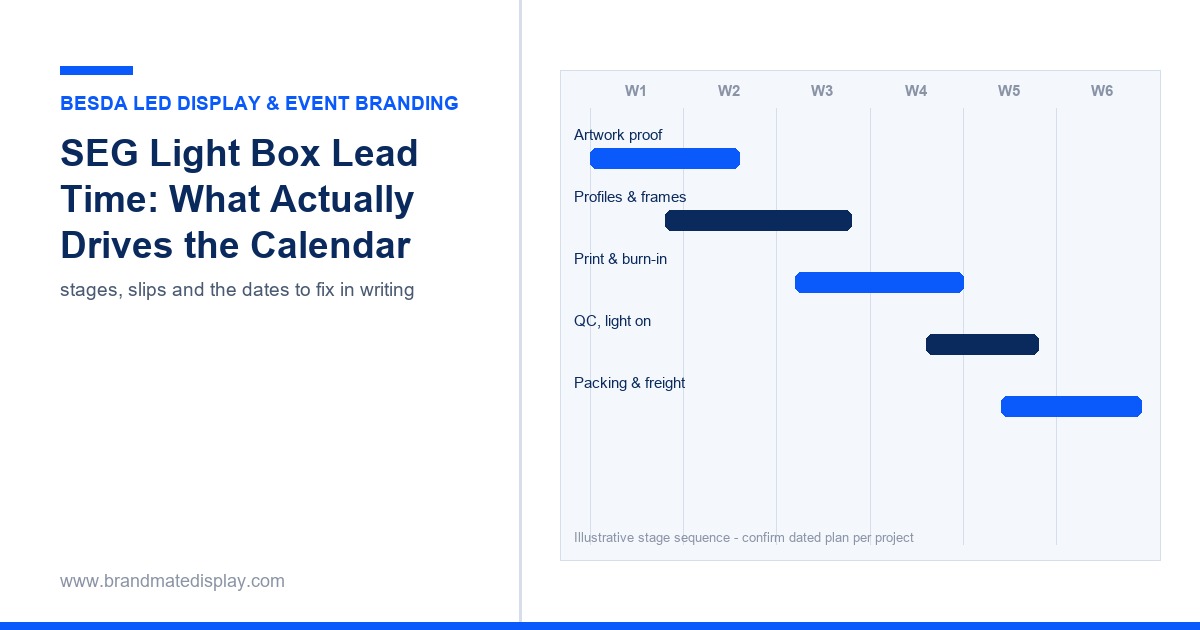
The five production stages are artwork proofing, profile and frame preparation, graphic printing with burn-in, assembly with QC, and packing. The sixth stage, freight booking and collection, sits outside the factory but inside your launch date.
A SEG order differs from a poster-frame order in one way that matters here: the graphic is part of the product. The fabric print, the silicone bead and the frame must be finished together, so a late artwork change stops three stages at once.
The quote answers “how much”. The calendar answers “when can I promise my own customer”. Retail rollouts, exhibition dates and mall approvals all sit on fixed dates, so the calendar is the commercial document.
Three dates decide whether a lead time is real: the artwork sign-off date, the sample approval date and the collection date. Fix those three in writing and the rest of the plan becomes checkable.
Everything else is a range. Print and burn-in run in days, sea freight in weeks, and a holiday shutdown can pause every stage at once. A supplier who gives one confident number for all of it is quoting a slogan.
Stage one is artwork proofing. The factory returns a dieline and a layout proof; the buyer checks content, spelling, orientation and colour references. Each revision round adds days, so batch your comments into one reply per round.
Stage two is profiles and frames. Standard 30 mm, 50 mm and 80 mm frame depths usually run from stock profile. Custom depths, curved frames and special finishes wait on extrusion or coating, and that wait belongs to the mill, not the assembly bench.
Stage three is printing and burn-in. The fabric is printed at the agreed weight, typically 110, 160 or 260 gsm, then the finished unit ages with the light on so drivers and LEDs settle before QC. Burn-in windows commonly run 24 to 48 hours; confirm the figure for your unit.
Stage four is assembly and QC with the graphic fitted and the light on. Uniformity is read against a target, colour against a reference, and the silicone bead is seated and re-seated. A unit checked without its graphic hides the faults that matter.
Stage five is packing: foam, corner protection, carton or crate, and a packing list that matches the container plan. Stage six is the booking. Courier collections take days, air freight days to a week door to door, and sea freight weeks plus port time.
Four slips cover most delayed projects:
None of these is a factory secret. All four can be seen in the first week, which is why the kickoff call, not the deposit, is the real start of the calendar.
| Mode | Transit shape | Best for | Watch out for |
|---|---|---|---|
| Courier | days, door to door | samples, spare graphics, urgent single units | size and weight limits per piece |
| Air freight | days plus handling | launch-critical batches | airport legs at both ends, volumetric rules |
| Sea freight | weeks plus port time | rollouts, full pallets and containers | sailing schedules, customs and destination legs |
| Sea + local courier | weeks, then days | multi-store deliveries from one port | deconsolidation time at destination |
Volumetric weight decides the real freight weight of the hurry. Large, light crates pay by volume, which is why the volumetric weight and pallet guide belongs in the calendar discussion, not just the budget one.

Lead time ends when goods are ready for collection. Shipping time starts there. A “two-week” production answer plus a multi-week sea leg is a different promise than the same production answer with a courier on standby.
Ask for the two numbers separately, with the collection date named. The delivery documents guide lists the paperwork that moves at the handover, and paperwork missing at collection day is a calendar slip nobody budgeted for.
| Situation | Verdict | What to do instead |
|---|---|---|
| Quote with no artwork round included | SKIP IT | Ask for a calendar with a proof round in it |
| Custom frame depth but no mill date | SKIP IT | Confirm extrusion date before the deposit |
| Burn-in skipped to save days | SKIP IT | Keep the 24–48 h ageing; faults surface there |
| QC without the graphic fitted | SKIP IT | Insist on light-on, graphic-on checks |
| Collection date set before packing spec | Risky | Fix crate size and packing list first |
| Launch tied to a sailing that may close | Risky | Book the sailing, then publish the launch date |
Send this with the RFQ and the answers come back checkable. The product fields match our technical specifications page.
| Item | Fix in writing |
|---|---|
| Artwork sign-off date | date and named reviewer |
| Sample round plan | which rounds, per the sample process guide |
| Frame depth and finish | 30 / 50 / 80 mm or custom, stock or mill date |
| Fabric weight | 110 / 160 / 260 gsm typical, confirm per project |
| Colour references | physical or digital standard agreed |
| Burn-in window | 24–48 h typical, confirm for the unit |
| QC method | graphic fitted, light on, uniformity target |
| Packing spec | crate sizes, protection, packing list |
| Freight mode | courier, air or sea, booked against launch date |
| Collection date | named date after packing approval |
| Holiday windows | shutdown dates confirmed for the year |
It depends on artwork rounds, frame stock, print capacity and freight mode, so confirm per project. What you can fix early are the three dates: artwork sign-off, sample approval and collection. A supplier who returns a stage plan with those dates is giving you a checkable calendar, not a slogan.
Artwork revision rounds and custom profiles. Both are visible in the first week. Batch your feedback, name one reviewer, and confirm stock status for the frame depth before the deposit.
The sea leg runs in weeks and air in days, but the full door-to-door picture includes port handling, customs and destination delivery. Compare door-to-door plans, not the leg in the middle.
We do not recommend it. A 24 to 48 hour burn-in window is what surfaces early driver and LED faults while the unit is still on the bench. The hours are cheaper at the factory than at your store; confirm the window for your unit.
A shutdown window of one to three weeks is typical around the Lunar New Year, and dates move each year. Ask your supplier for the exact window, then plan collections either side of it.
The stage plan, the three dates, the graphic spec, the QC method and the packing spec. If any of the five is missing, the calendar is a guess regardless of the number quoted.
Lead time is a stage plan with three dates in it, not a number on a quote. Artwork rounds and profile stock are visible in week one; burn-in, QC and packing are checkable at the bench; freight turns the plan into a launch date.
Ask for the stages, fix the three dates, and the calendar becomes something you can hold both sides to. The SEG fabric light box product page lists what to specify, and the rollout specification guide shows how the same calendar scales across stores.
We will reply within 2 hours.
Prefer a form? Send the layer count, ceiling height and site photos below, or use the contact page.