Address
Caochang Industrial Area, Liguang Rd, Lishui, Nanhai, Foshan, Guangdong, China
Phone:
0086-20-8938 9313
0086-757-8938 9313
Email:
Work Hours
Monday to Friday: 8AM - 10PM
24x7 online service

Address
Caochang Industrial Area, Liguang Rd, Lishui, Nanhai, Foshan, Guangdong, China
Phone:
0086-20-8938 9313
0086-757-8938 9313
Email:
Work Hours
Monday to Friday: 8AM - 10PM
24x7 online service
Custom LED Light Box & SEG Display Manufacturer
 Byadminn
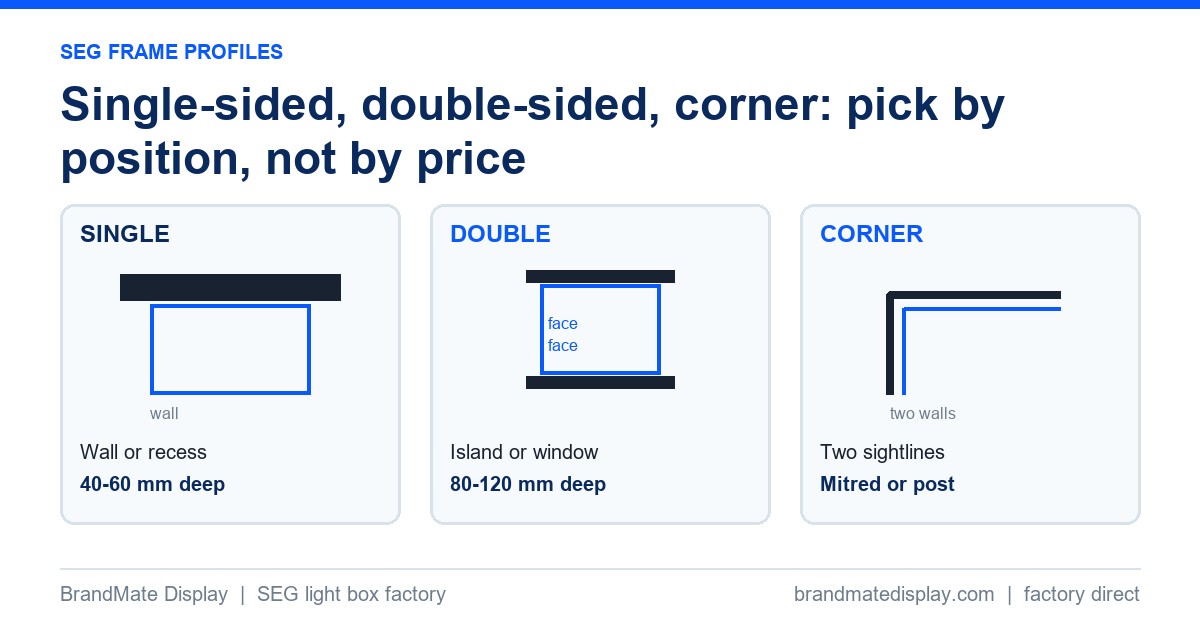
SEG frame profiles decide how a light box sits in a room. A wall unit needs one groove. A corner unit needs a joint that carries the groove around 90 degrees. An island unit needs two faces back to back. Pick the position first, then the depth, then the groove size.
A SEG frame profile is an extruded aluminum bar with a continuous groove on one face. The groove holds the 10 mm or 12 mm silicone edge sewn to a polyester graphic. Fabric tension keeps the face flat, not clips or a vacuum pump.
It is not a picture frame with a printed board inside. The graphic is flexible, the frame is hollow, and the LED modules sit behind the fabric. That hollow space is why depth matters more than face width on most retail units.
Three geometries cover most shop work. A single-sided profile has one groove and a closed back. A double-sided profile has two grooves facing opposite directions. A corner profile is mitered at 45 degrees, so two legs meet on a 90-degree wall.
Most factories extrude all three from 6063 aluminum. What separates them is groove count, wall thickness, and how the corner joint is made: keyed, welded or cast.
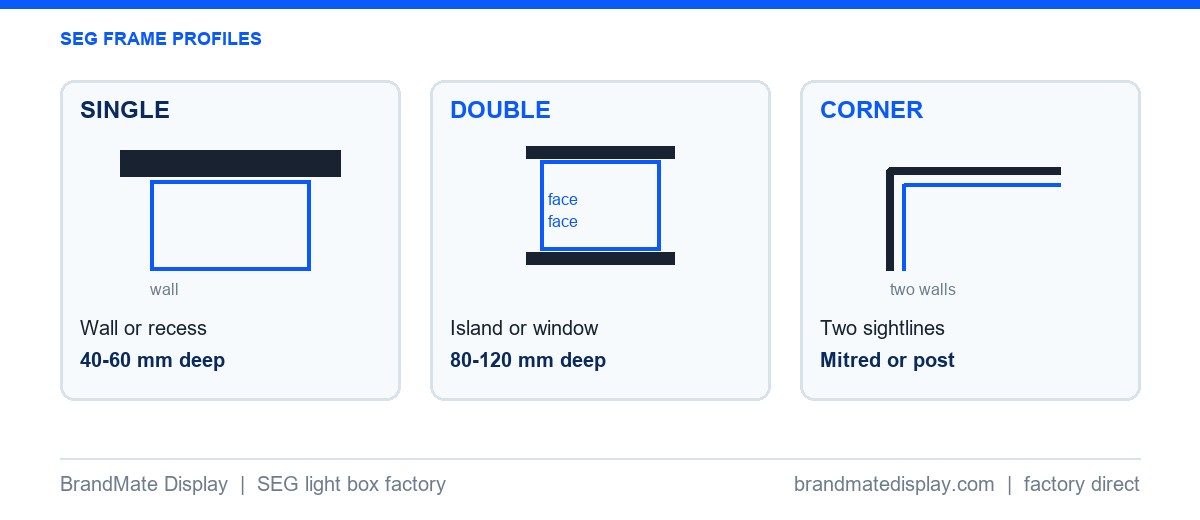
The profile sets the failure mode. A 30 mm frame on a wall gives a thin shadow line. The same frame on an island leaves the back visible, and light spills onto the floor.
The profile also sets graphic cost. Two faces on one island unit mean two printed panels and two silicone edges. A corner unit needs two panels cut square and joined at the miter.
Wall thickness is the variable buyers skip. Profiles in this size class run 1.5-2.5 mm typical. Below 1.5 mm, a 1,200 mm span can bow under fabric tension. Ask for measured thickness in millimetres and a flatness tolerance on the drawing.
Last, the profile decides the service route. A front-loading groove lets one person change a face without tools. A rear panel adds a step ladder to every graphic change, at every site.
The groove is the working part. A 10 mm silicone edge needs a groove about 10.5-11 mm wide. A 12 mm edge needs more. Mixing edge sizes across a rollout is the most common reason a new graphic will not seat.
Tension comes from the print, not the frame. Panels are printed 1-2% smaller than the opening, so the silicone edge compresses into the groove and pulls the face flat. Fabric weight changes the pull: 110, 160 and 260 gsm are the usual options.
Behind the fabric, LED modules sit on a back panel or an inner rail. Direct-lit units often run near 100 mm module pitch with 120 mm of depth. A 30 mm profile cannot do that, so it uses edge-lit bars or a denser pitch.
Diffusion distance decides uniformity. Measured on a 9-point grid, good units hold 85-95% min-to-max. Thin profiles with a short diffusion gap often land at 60-70%, which reads as a bright centre and grey corners.
The corner joint carries the groove through 90 degrees. A keyed joint uses an internal corner key plus two screws. A cast block is stronger but takes 40-60 mm of face. The groove must stay continuous, or the fabric lifts at the miter. The frame depth guide sets the depth and the joint on one drawing.
A wall position rewards a 30-50 mm single-sided profile. The box sits 10-20 mm off the wall on standoffs. The driver hides behind the back panel, and the face lines up with the signage beside it. The wall mounting guide covers fixings and substrate load.
A corner position needs a measured angle, not an assumed one. Site corners often run 88-92 degrees. Ask for a template or a diagonal measurement before the miter is cut. Then confirm which leg carries the driver.
An island position usually needs about 80 mm of depth. Two LED rows, two diffusers and a central spine have to fit inside. Below 50 mm on a 600 x 1200 face, expect a hot band down the middle.
High mounting changes the numbers. At 4 m, a 600 x 1200 face at 60-80 W reads as a soft panel unless CRI and CCT are controlled. Ask for CRI 90 or above and one CCT band, 3000-6500K, per project.
The table filters the position before a quotation. Groove count and depth change the extrusion, the LED count and the packing size more than face width does.
| Option | Faces and grooves | Typical depth | Best position | SKIP IT when |
|---|---|---|---|---|
| Single-sided, 30 mm | 1 face, 1 groove, closed back | 30 mm | wall, column face, window return | the back is seen from a second aisle |
| Single-sided, 50 mm | 1 face, 1 groove, driver cavity | 50 mm | wall with a long span or a thick driver | the wall clearance is under 40 mm |
| Double-sided, 80 mm | 2 faces, 2 grooves, central spine | 80 mm, up to 120 mm for large faces | island plinth, freestanding partition | the unit stands within 300 mm of a wall |
| Corner, 90 degrees | 2 faces on two legs, continuous groove | 50-80 mm | inside corner, pillar return | the wall angle falls outside 85-95 degrees and no template is taken |
| Four-sided box | 4 faces, 4 grooves | 80-120 mm | open island with traffic on all sides | only two sides are ever seen |
Read the SKIP IT column first. A double-sided unit against a wall wastes a face and adds weight. A single-sided unit on an open island shows its back to half the shop.
A corner unit is not two single-sided units bolted together. Two separate boxes leave a dark vertical strip at the joint and put two back panels in the way. A corner profile shares one spine and a continuous groove path.
The graphic is the second difference. One panel cannot wrap a 90-degree corner without a sewn corner or a stretch fold. Most corner units take two panels cut square and joined at the miter. Artwork needs 20-40 mm of bleed into the joint.
Service is the third. On a wall unit, one person lifts the face out from the front. On a corner unit, the leg nearest the wall may need the box loosened first. Plan that access before the fixing holes are drilled.
The profile is worth the engineering when the box is permanent, the face is longer than 1 m, or the same artwork repeats across sites. A frame with too little tension becomes a maintenance line item, and the tension and storage guide explains the causes.
Skip it when:
A frame with too little tension becomes a service call. Ask for a profile sample and one face fitted to it before the full order.
Send these fields with the inquiry and the quotes come back comparable. The same fields appear on our technical specifications page.
| Item | Confirm on the drawing or sample |
|---|---|
| Profile | 6063 alloy, wall 1.5-2.5 mm, finish specified |
| Groove | 10 mm or 12 mm, measured at three points |
| Face size | width x height in mm, plus bleed for the silicone edge |
| Depth | 30, 50 or 80 mm, chosen from the position |
| LED layout | module pitch in mm and diffuser distance |
| Light quality | CRI, CCT band, uniformity target 85-95% |
| Power | driver per face, four faces maximum per driver, 60-80 W for 600 x 1200 |
| Fabric | 110, 160 or 260 gsm, silicone edge size |
| Joint | measured corner angle, key or cast block, seam position |
| Test and packing | 24-48 h burn-in record, crate count, corner protection |
Most are extruded 6063 aluminum, anodized or powder-coated. The groove is part of the extrusion, not a separate strip. Ask for the alloy, the measured wall thickness and the coating type.
Choose by what the back faces. A wall, column or window return takes a single-sided frame with a closed back. An open floor position takes a double-sided frame with a central spine.
It can be built that way, and it usually shows a dark strip at the joint. A mitered corner profile with a keyed or cast joint keeps the groove continuous, so the fabric stays flat through the turn.
1.5-2.5 mm is the usual range for retail sizes. Below 1.5 mm, a 1,200 mm span can bow once the fabric is tensioned. Ask for the thickness and a flatness tolerance on the drawing.
Measure nine points across each face with a lux meter, then compare the lowest reading with the highest. Good units hold 85-95%. Thin frames with a short diffusion gap often sit at 60-70%.
Yes in most cases. Two panels meet at the miter, so artwork needs 20-40 mm of bleed. Confirm the panel split and the seam position before print.
Choose the position, then the profile. A wall takes a single-sided 30-50 mm extrusion. An island takes a double-sided 80 mm frame. A corner takes a mitered profile with a joint detail on the drawing.
Then check the numbers that decide the result: wall thickness, groove width, LED pitch, driver count and a written uniformity target. A quote without those figures cannot be compared, and a SEG light box ordered on face size alone is a guess.
BrandMate Display is a light box manufacturer and factory, supplying wholesalers and chain buyers.
We will reply within 2 hours.
Prefer a form? Send the position photos, the wall angle and the face size below, or use the contact page.