Address
Caochang Industrial Area, Liguang Rd, Lishui, Nanhai, Foshan, Guangdong, China
Phone:
0086-20-8938 9313
0086-757-8938 9313
Email:
Work Hours
Monday to Friday: 8AM - 10PM
24x7 online service

Address
Caochang Industrial Area, Liguang Rd, Lishui, Nanhai, Foshan, Guangdong, China
Phone:
0086-20-8938 9313
0086-757-8938 9313
Email:
Work Hours
Monday to Friday: 8AM - 10PM
24x7 online service
Custom LED Light Box & SEG Display Manufacturer
Custom curved tradeshow display systems for exhibitions, presentation areas and branded backwalls where a concave or convex profile improves sightlines and booth flow.
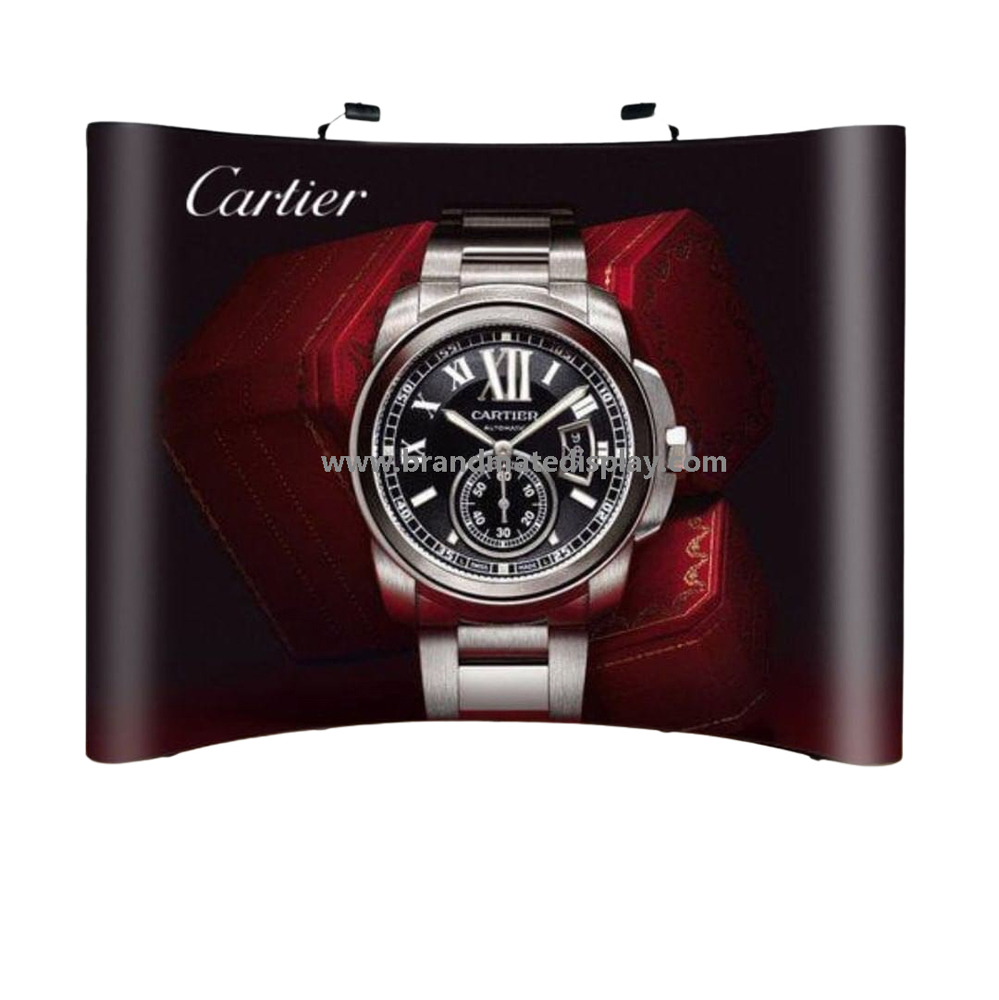
A curved tradeshow display uses a controlled arc to create a softer visual boundary than a straight wall. Buyers should define the curve direction, radius/overall depth, viewing side and usable booth footprint before production.
| Buyer decision | What to confirm |
|---|---|
| Curve direction | Concave, convex or project-specific orientation |
| Depth | How far the curve projects into the booth |
| Graphic template | Artwork mapped to the actual arc |
| Base stability | Feet/base position and traffic clearance |
| Sectioning | How the curved frame breaks down for transport |
The curved frame should be reviewed in both front and plan views. A wall that appears compact from the front may consume more floor depth than expected because of the arc.
Curved graphics need the correct template and orientation. Logo placement should be checked near the edges because perspective can make artwork appear compressed from oblique viewing angles.
The assembly reference should make the curve direction obvious and identify the correct order of frame sections. This is especially important when several curved modules look similar in their packed form.
Curved profiles and connectors should be protected from bending or impact. Keep the graphic and frame reference together so replacement graphics can be ordered accurately later.
Approve curve direction, radius/overall depth, footprint and installation clearance. The installed system needs usable clearance beyond the print dimensions; review both front and plan views before the design is released for manufacture.
For this concave or convex curved graphic backwall, confirm actual frame profile, profile orientation labels, connectors and ground supports, finish and any sectional construction. Do not assume a shape or material grade from photographs of another tradeshow display category.
Identify whether the buyer needs one or two usable viewing directions. A second graphic face may change the frame/attachment system and packed content. Confirm orientation and artwork identification for every printed surface.
Use the curved graphic template and seam placement, keeping visible print area, seam/bleed locations, graphic attachment and revision number together. Replacement graphics should reference the original frame model rather than a nominal display size alone.
Installers should direction-coded curved profiles and stable feet. Photograph the assembled structure and document part positions, crew/tool requirements and graphic installation sequence. Quote setup time only when a specific model and test condition exist.
Before purchase check booth depth/aisle clearance and event height limits, any venue labor rules, installation working area and the freight arrival timetable. If the unit includes electrical components, confirm qualified installation requirements separately.
Include profile orientation labels, connectors and ground supports and any bag/case, graphics and labels in a part list. For repeat events, identify the exact replacement part codes and ensure the onsite team can distinguish visually similar components.
Inspect graphic tension, curved frame alignment and base fit, surface finish, hardware completeness and graphic fit. Check a complete assembly against the packing list before dispatch, with dated inspection photographs for projects requiring traceability.
Confirm carton/carry-bag size, longest component, number of cases and gross weight—not only installed dimensions. Protect print surfaces and frame ends and label all parts for easy unpacking.
Plan repeat installations using the correct curve-profile graphics. Check support parts after each event, clean/dry prints as recommended, repack in their assigned locations and keep graphics/templates and assembly notes with the order record.
| Detail | Buyer specification |
|---|---|
| Product | Curve Shape Trade Show Display |
| Installed size | curve direction, radius/overall depth, footprint and installation clearance |
| Graphic requirement | curved graphic template and seam placement |
| Assembly | direction-coded curved profiles and stable feet |
| Accessories | profile orientation labels, connectors and ground supports |
| Venue | booth depth/aisle clearance and event height limits |
| QC | graphic tension, curved frame alignment and base fit |
| Order | Quantity, destination, artwork readiness, case/packing preference, event date |
Our curved-display process starts with geometry and booth footprint before artwork. That gives buyers a clearer basis for layout approval, transport and installation.
Custom curved dimensions can be reviewed according to the frame system and project footprint.
Yes, depending on the selected design and installation requirement.
Selected structures can be reviewed for double-sided graphics when required.
Related: Tradeshow Display Manufacturer · Quality Control · Warehouse & Logistics
Compare the formats that buyers usually shortlist for the same project.
Send the display type, visible size, quantity and destination. We will reply within 2 hours. If your project is confidential, tell us at first contact and we will keep it under NDA.