Address
Caochang Industrial Area, Liguang Rd, Lishui, Nanhai, Foshan, Guangdong, China
Phone:
0086-20-8938 9313
0086-757-8938 9313
Email:
Work Hours
Monday to Friday: 8AM - 10PM
24x7 online service

Address
Caochang Industrial Area, Liguang Rd, Lishui, Nanhai, Foshan, Guangdong, China
Phone:
0086-20-8938 9313
0086-757-8938 9313
Email:
Work Hours
Monday to Friday: 8AM - 10PM
24x7 online service
Custom LED Light Box & SEG Display Manufacturer
 Byadminn
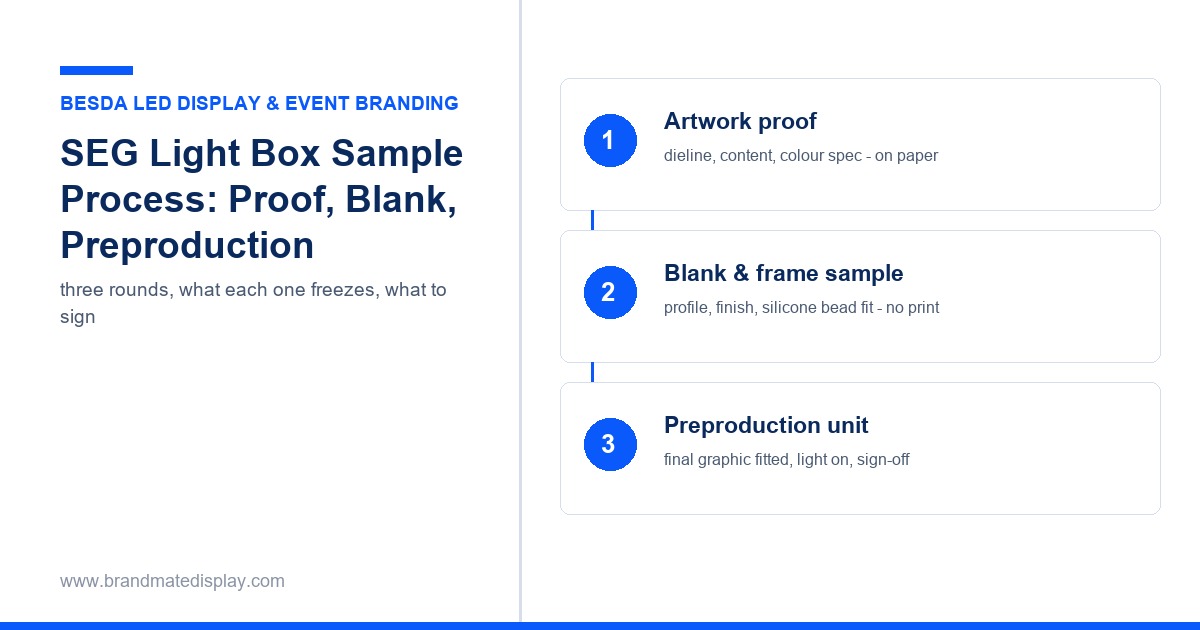
The SEG light box sample process runs in three rounds: an artwork proof on paper, a blank frame sample without print, and a preproduction unit with the final graphic fitted and the light on. Each round freezes a different layer of the specification, so skipping one does not save time; it moves the risk to the stage where mistakes are most expensive.
A sample round is a decision gate, not a free preview. Round one freezes content: dieline, wording, orientation, colour references and the size relation between frame and graphic. Round two freezes hardware: profile depth, finish, corner joints and the way the silicone bead seats in the slot. Round three freezes the pair: print quality against the agreed fabric, brightness and uniformity with the graphic fitted.
That is why “can we skip the blank sample” is the wrong question. The blank round is where fit problems are found while they are still cheap. The question that matters is which layer each round freezes, and whether that layer is settled.
Bulk production copies round three. If round three was never really approved, production is copying nothing.
Round discipline also protects the calendar. A fault found at the proof round takes one reply. The same fault found after bulk printing adds reprint, burn-in and QC time, which is exactly the chain described in the lead time calendar guide.
And rounds protect the buyer’s own approval chain. Store managers, brand teams and mall landlords all sign against something. A dated sample revision number gives each of them a document to sign, instead of a screenshot.
Round one, the artwork proof. The factory returns a dieline plus a layout proof, on paper or screen. You check spelling, orientation, fold and seam positions, colour references and the visible area. Sign it with a revision number. Two revision rounds are typical; confirm per project.
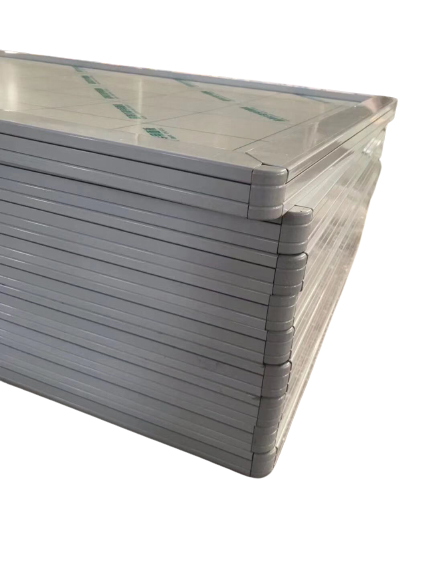
Round two, the blank and frame sample. A frame is made to the drawing with no print: profile depth, finish, corner quality, bead fit and, where relevant, the fixing points. This is the round where the silicone bead tolerance is proven, because a bead that seats wrong shows on a blank frame as clearly as on a print.
Round three, the preproduction unit. The final fabric, typically 110, 160 or 260 gsm, is printed, fitted and lit. This is the sign-off unit, and it is where the 22-check acceptance list runs: measurements, lighting, graphics, accessories and the record you keep. Uniformity is read against a target, colour against the agreed reference, and CRI against the lamp spec.
The proof round is the cheapest place to be wrong. A wrong fold line takes one reply; the same mistake after printing takes a reprint, another burn-in and another QC pass.
The blank round is the only place frame errors are cheap. A bead slot that fights the graphic, a corner that shows a gap, a fixing point nobody measured: all of these are found on a frame that carries no print.
The preproduction round is the only real rehearsal of bulk. It runs the full chain, print to packing, and produces the reference unit that bulk copies. Photograph it, measure it, and keep its revision number with the order.
| Aspect | Round 1: Artwork proof | Round 2: Blank & frame | Round 3: Preproduction |
|---|---|---|---|
| What you see | dieline and layout on paper or screen | real frame, no print | finished unit, graphic fitted, lit |
| What it freezes | content, sizes, colour spec | profile, finish, bead fit, fixings | print quality, brightness, uniformity |
| Exposure if wrong | a reply | a frame remake | print, burn-in and QC again |
| Who signs | brand or marketing owner | project or installation owner | buyer of record, dated revision |
| Typical output | PDF proof with rev number | sample photos plus measurements | the reference unit plus a QC record |
| Remote review | yes | photos and video usually enough | photos, video and the 22-check record |
The rounds are the sequence. The 22 checks are the record you keep at the third round. One orders the work; the other proves it was done.
Buyers who confuse the two either approve too early, because a checklist exists, or too late, because they wait for a perfect sample instead of signing each layer at its own gate. Run the rounds in order and apply the checklist where it belongs: on the preproduction unit, with the light on.
| Situation | Verdict | Why |
|---|---|---|
| Reorder against an unchanged template | Skip rounds 1 and 2 | Both layers are already frozen; go to repeat production |
| Colour-critical campaign on a new fabric | SKIP skipping round 3 | Colour shifts live at the print layer |
| New frame depth or custom finish | SKIP skipping round 2 | Bead and corner fit are unproven |
| Same artwork, new size | Keep round 1 | A resized dieline changes seams and visible area |
| Chain rollout with site variants | Keep rounds 2 and 3 on the first site | Variants inherit, they do not prove themselves |
| Sample couriered for a look only | Fine, but not approval | Look is one layer; fit and light are the others |
Keep these five documents together. They are the difference between “approved” as a feeling and “approved” as a record, and they feed the artwork version control system on multi-store work.
| Document | What it proves |
|---|---|
| Signed dieline and proof, rev-numbered | content, sizes, colour spec frozen |
| Frame sample report with measurements | profile, finish, bead fit, fixings frozen |
| Preproduction QC record, light on | uniformity, colour, CRI, graphics frozen |
| Photo set of the reference unit | what bulk must look like, without light and with |
| Packing and label spec | what the approved unit ships like |
Three rounds: an artwork proof that freezes content and sizes, a blank frame sample that freezes hardware and bead fit, and a preproduction unit with the final graphic fitted and lit for print and lighting. Bulk copies the third round, so that is the one to sign properly.
Only when both layers it freezes are already proven: a repeat order against an unchanged template. With a new depth, finish or supplier, the blank round is where fit problems are cheap. Skipping it moves the same problems to the print stage, where they take longer.
One to two rounds are typical when feedback is batched; confirm per project. Rounds stretch when comments arrive in pieces, which is why one named reviewer per round is the single best calendar protection.
Yes, with measured photos and video rather than mood shots: frame corners without light, bead seating at a low angle, uniformity with the light on, and the QC record beside the unit. On-site review remains useful for the first rollout of a new family.
Round one, whoever owns content and brand. Round two, whoever owns installation and site fit. Round three, the buyer of record, with a dated revision number that bulk production will reference.
It becomes the reference unit. Keep it, or keep a full photo set and its QC record, and any later dispute becomes a comparison instead of an argument. Reorders then run against the same revision without new rounds.
Three rounds, three freezes: content, hardware, print-and-light. Sign each at its own gate with a revision number. Run the 22 checks on the preproduction unit, and bulk production has nothing left to invent.
If the calendar is tight, protect the rounds instead of cutting them; the rounds are where days are saved. The fabric weight guide and the colour proofing guide each cover one layer in depth.
We will reply within 2 hours.
Prefer a form? Send the layer count, ceiling height and site photos below, or use the contact page.