Address
Caochang Industrial Area, Liguang Rd, Lishui, Nanhai, Foshan, Guangdong, China
Phone:
0086-20-8938 9313
0086-757-8938 9313
Email:
Work Hours
Monday to Friday: 8AM - 10PM
24x7 online service

Address
Caochang Industrial Area, Liguang Rd, Lishui, Nanhai, Foshan, Guangdong, China
Phone:
0086-20-8938 9313
0086-757-8938 9313
Email:
Work Hours
Monday to Friday: 8AM - 10PM
24x7 online service
Custom LED Light Box & SEG Display Manufacturer
 Byadminn
Magnetic vs snap frame is decided by one question: how often the poster changes. A magnetic front peels off flat and takes daily changes without hardware wear; a snap frame opens on four aluminium edges, which are cheap to make but take the wear when changes are constant. This guide walks the wear points, the change routines and a verdict matrix by change frequency.
Survival is not about the first week; every face system works when it is new. Survival is what the opening mechanism looks like after a few hundred change cycles.
Three things decide it: what the hand touches, what flexes, and what collects dirt. A system that survives daily changes keeps its opening force, its flatness and its edge line after all three have taken a year of contact.
The poster itself matters as much as the frame. Thin stock, clean edges and one sheet per change protect any system; curled edges and stapled bundles damage both.
Frequency sets how many times the mechanism is exercised. A quarterly change exercises it four times a year; a daily menu board exercises it hundreds of times before the first quarter ends.
Frequency also sets who does the work. Rare changes are done carefully by someone who owns the unit; daily changes are done fast by whoever is on shift, usually without reading any instructions. A daily system must therefore be forgiving of speed.
That is the whole comparison in one line: the magnetic front forgives speed because its face has nothing to bend. The snap frame keeps the profile simple, but it asks for a trained closing habit.
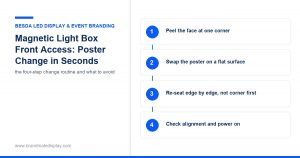
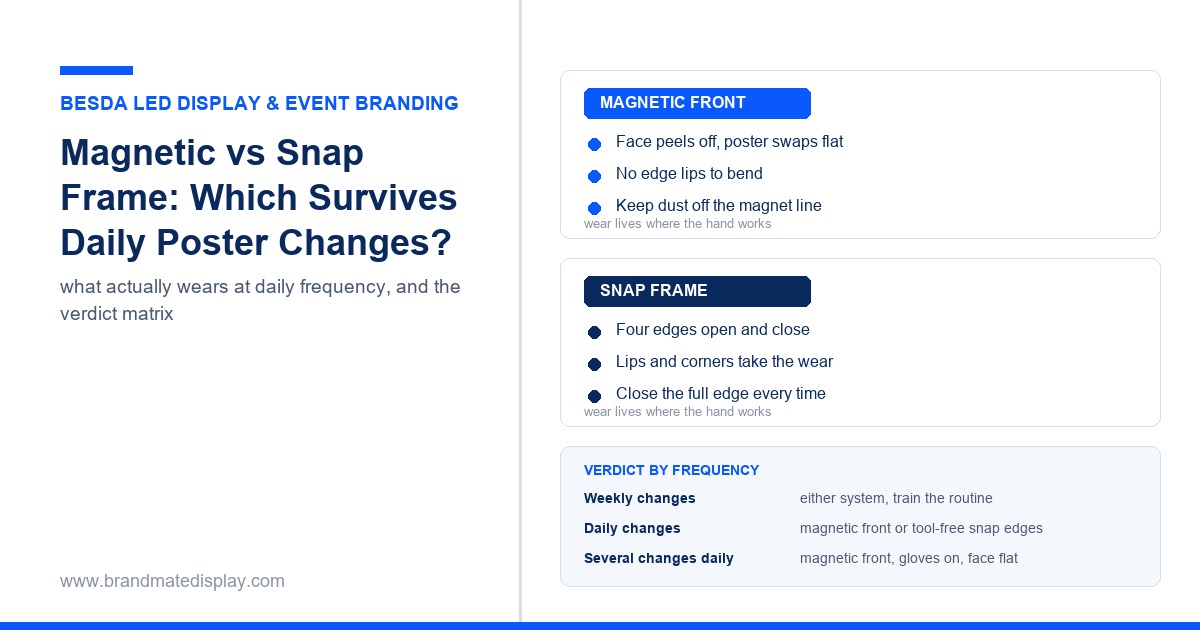
The magnetic front. The printed face is held by a magnet line around the frame opening. A change peels the face at a corner, swaps the poster on a flat surface, wipes the line and re-seats. Nothing bends because nothing hinges; the routine is covered step by step in the front access guide.
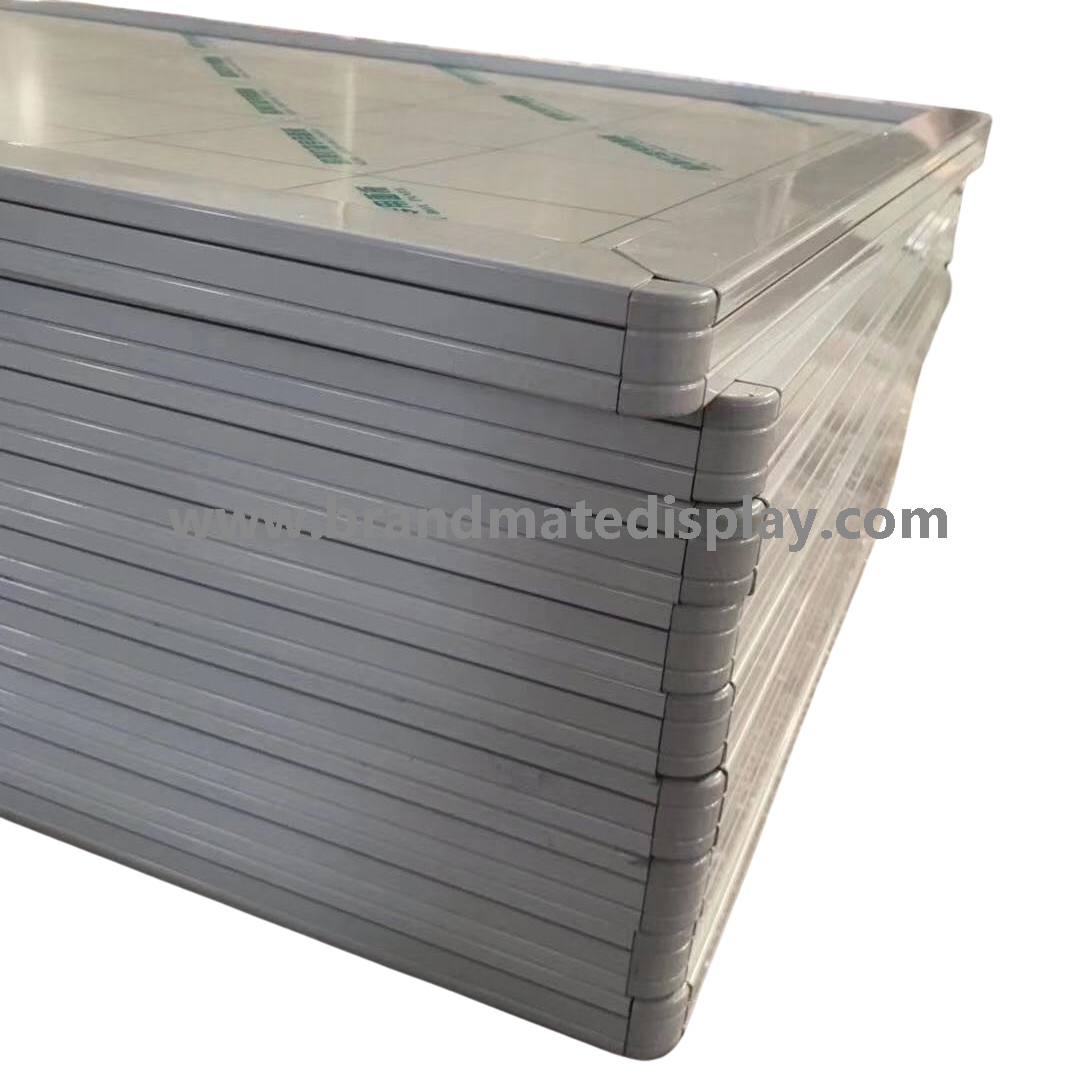
The snap frame. Four aluminium profiles hold the poster under their front lips. A change lifts each edge open, lays the poster in and presses the lips closed along the full length. The frame stays on the wall the whole time, which is why the system is a fixture favourite.
The snap frame’s exposure is exactly where it works: the lips. Bent by fingernails, tools or a poster pulled while an edge is still closed, a tired lip shows as a visible gap that reads as a wave from across the room.
The magnetic front wins wherever changes are frequent and staff rotate: counters, menu boards, lift lobbies and store windows. Its face has no lips to train anyone on.
The snap frame wins on simplicity and look. It is a slim architectural profile, it mounts like a picture frame, and for monthly or campaign-cycle changes its lips live for years. It also takes standard poster sizes off the shelf, which the poster size and visible area guide turns into a specification.
Neither system owns the middle ground. Both survive daily changes; the difference is what the operator must keep doing to earn that survival.
| Aspect | Magnetic front | Snap frame |
|---|---|---|
| Opening | face peels off in one piece | four edges open in turn |
| What takes the wear | the magnet line, if dust is left on it | lips and corner springs |
| Trained time per change | under a minute typical | a minute or two, edge by edge |
| Forgives speed | largely yes | partly; lips need a full close |
| Wall presence | cabinet with a face panel | slim picture-frame profile |
| Poster sizes | face made to order | standard sizes off the shelf |
| Best frequency | daily to weekly | weekly to campaign-cycle |
| Failure you will see | bright dots or lifted corners | edge gaps that read as waves |
On a magnetic front, wear concentrates on the magnet line. Staple offcuts, paper dust and iron filings sit between face and line; the symptom is a bright dot or a lifted corner, and the fix is one dry wipe at every change.
On a snap frame, wear concentrates on the lips and corners. Opening with a tool, closing only the middle of an edge, and pulling a poster while an edge is still closed bend the profile. The symptom is a gap along the edge that pressing later will not fix.
Neither failure is a defect; both are habits. The three-family comparison covers how both sit next to crystal acrylic faces; here the question is only which habit your team will actually keep.
A campaign-cycle unit changes a handful of times a year with planning behind each change. A daily unit changes with whatever hands are on shift. Buying the second like the first is how fixtures end up looking tired within a season.
Specify the daily case explicitly: who changes, how often, at what height, and whether gloves are realistic. The answer moves the choice more than any profile drawing does.
| Change frequency | Verdict | Why |
|---|---|---|
| Monthly or less | Either system | Both mechanisms barely get exercised |
| Weekly | Either, train the routine | Wear is habit-driven at this rate |
| Daily | Magnetic front, or tool-free snap edges | No tool use, minimal lip stress |
| Several times daily | Magnetic front, gloves on, face flat | Zero bending actions per change |
| Several daily + rotating casual staff | SKIP the snap frame | Lip damage is a when, not an if |
| Several daily + locked position needed | SKIP both; ask about locking fronts | Security outranks convenience |
Run this check monthly on high-frequency units; it is five minutes per site and catches both failure modes early.
| Check | Magnetic front | Snap frame |
|---|---|---|
| Seating line | clean, face sits flush all round | lips closed full-length on all edges |
| Corners | no chips, face square | corner springs still close tight |
| Surface | no bright dots when lit | no waves visible at 2 m |
| Poster | one sheet, edges clean | one sheet, no curled edges |
| Routine | corner peel, flat swap, wipe, re-seat | all edges open, full close, no tools |
For daily changes the magnetic front has the edge because nothing bends during a change. A snap frame survives daily changes too, but only while staff open all edges, close them full-length and never use tools. If rotation makes habits unreliable, pick the magnetic front.
The profile itself lasts; the lips and corner springs are the wear items. Tool use and partial closing shorten their life. Well-trained hands keep a snap frame serviceable for years at daily frequency; casual hands shorten it to a season.
For indoor positions, yes: the magnet line is continuous and the face sits flat under normal knocks. Arm-height positions in busy aisles deserve a risk check with the supplier, and locking options exist where security matters.
Yes, and it is the normal answer: magnetic fronts at counters and menu boards that change daily, snap frames in corridors and windows that change per campaign. Mixing by frequency is cheaper than forcing one system everywhere.
Gaps along the edges that stay open, corners that will not close tight, and a poster that reads as wavy from two metres. If pressing by hand does not close it, the profile needs replacing, which is a spare-parts job rather than a new unit.
Real change frequency, who changes, mounting height, poster sizes against the visible area, and whether the position needs locking. With those five answers, the frame choice makes itself.
Magnetic vs snap frame is a frequency question. Rare changes make both systems permanent; daily changes hand the decision to the magnetic front unless your team demonstrably keeps the snap routine.
Count the real changes, run one trial unit with actual staff, and let the mechanism earn the rollout. The snap frame product page and the magnetic light box product page both list sizes and RFQ fields, and our technical specifications page holds the lighting criteria that apply to either face.
We will reply within 2 hours.
Prefer a form? Send the layer count, ceiling height and site photos below, or use the contact page.