Address
Caochang Industrial Area, Liguang Rd, Lishui, Nanhai, Foshan, Guangdong, China
Phone:
0086-20-8938 9313
0086-757-8938 9313
Email:
Work Hours
Monday to Friday: 8AM - 10PM
24x7 online service

Address
Caochang Industrial Area, Liguang Rd, Lishui, Nanhai, Foshan, Guangdong, China
Phone:
0086-20-8938 9313
0086-757-8938 9313
Email:
Work Hours
Monday to Friday: 8AM - 10PM
24x7 online service
Custom LED Light Box & SEG Display Manufacturer
 Byadminn
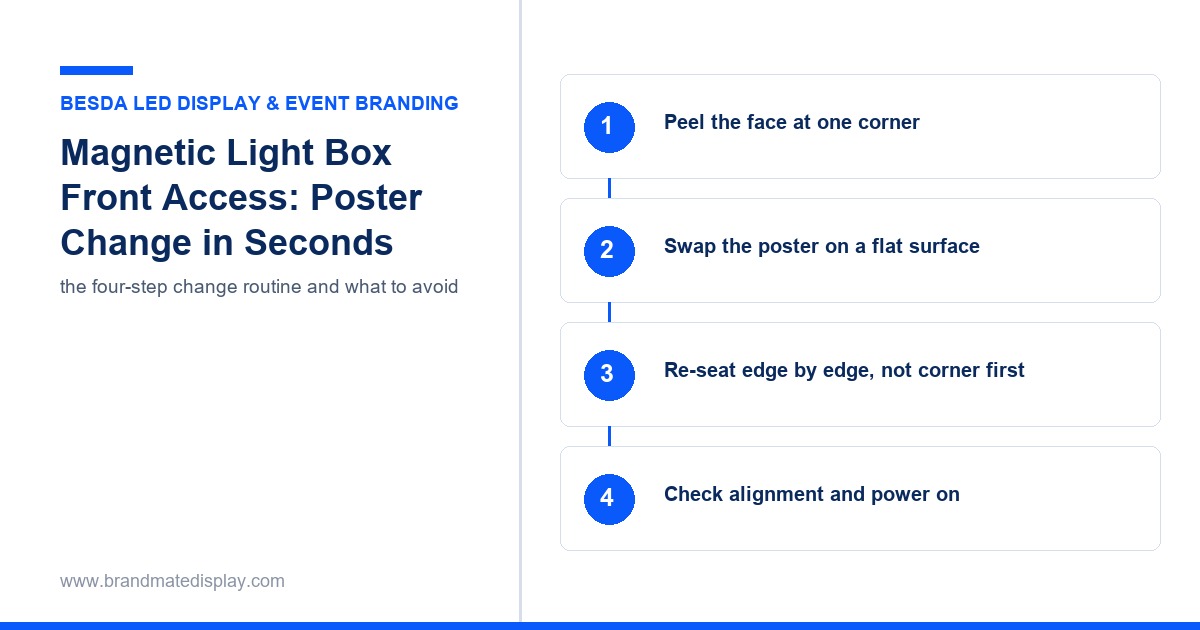
Magnetic light box front access means the printed face is held to the cabinet by magnets around its perimeter, so staff change the poster from the front without taking the unit off the wall. This guide covers how the front works, the four-step change routine, where front access earns its keep, and the situations where another face system fits better.
A front-access magnetic light box is a layered cabinet. The printed face sits on top, the poster sits under it, and the light panel sits behind. A steel sheet or magnetic strip line runs around the frame opening, and the face holds itself to that line.
“Front access” is the operational claim: no rear door, no wall removal, no tools. The whole face comes off in one piece, the poster swaps on a flat surface, and the face goes back in seconds.
The claim only holds if the routine is trained. A face peeled from the middle, a poster swapped in the air and a face dropped back at one corner produce exactly the smudges and waves that make buyers blame the product. The system is simple; the routine is what makes it look simple.
Poster changes are a staffing cost, not a product feature. A change that takes one person, no ladder and no tools runs on any shift. A change that needs two people runs when the manager finds time, which means the content goes stale.
Stale content is the real expense. A menu board that still shows last week’s special reads as neglect from the counter, and no lighting spec fixes that.
The routine also protects the product. Faces lifted flat and re-seated edge by edge keep their print for years. Faces flexed, dragged and dropped onto the magnet line gather wear that no warranty covers. The replacement faces guide covers what happens when a face does need changing; the routine below is how to postpone that.
The holding force is a line of magnets, not one big magnet. That design has two consequences buyers care about.
First, the face aligns itself. Bring the face near the frame and the magnet line pulls it square; the perimeter does the fitting, not the person. A face dropped near its edge finds its own position.
Second, the force is even. Because the pull is distributed around the opening, the face sits flat without visible pressure points, which is why the front reads as one smooth surface once lit.
What the design asks for is a clean line. Dust, staple offcuts and ferrous debris on the magnet line create exactly the bumps that show under even illumination, so the cleaning step in the routine is not cosmetic. The lighting itself follows the same rules as any cabinet: uniformity read with the graphic fitted, and CRI at the lamp spec, as on our technical specifications page.

Four settings get most of the value:
The common thread is frequency. The more often content changes, the more the no-tools routine repays itself. A graphic that changes once a year does not need front access at all, and the three-family comparison is the better starting point for that decision.
| Aspect | Magnetic front access | Wall-detach cabinet | SEG fabric face |
|---|---|---|---|
| Change from | front, face off in one piece | unit off the wall | front, bead out of slot |
| Tools | none | fixings and a second pair of hands | none, but a blunt tool helps |
| Face material | printed panel or thin board | printed panel | textile with silicone bead |
| Best frequency | daily to weekly | rare | campaign cycles |
| Trained time per change | under a minute typical | a job, not a task | 1–3 min typical |
| Watch for | dust on the magnet line | wall finish wear | corner-first re-seating waves |
A rear-access cabinet is not a worse product; it is a different install. Rear doors keep the front glass-clear and suit built-in joinery where the cabinet is part of the furniture. The trade is operational: every change needs access behind the unit, which means moving it or building the access into the wall.
Buyers who confuse the two usually order rear access for a position that changes weekly, then discover the change job never happens. Ask one question at specification time: who changes this, how often, and what stands behind the unit? The answer decides the face system, not the catalogue order.
| Situation | Verdict | What to do instead |
|---|---|---|
| Graphic changes once a quarter or less | SKIP IT | Rear access or a fixed-face cabinet |
| Semi-outdoor position with wind load | SKIP IT | A locked or gasketed cabinet |
| Poster thicker than the designed stack | SKIP IT | Confirm stack spec before ordering |
| Face must sit behind glass or acrylic cover | SKIP IT | Snap frame under a cover instead |
| High-touch position with greasy hands | Risky | Gloves at the routine, or recess the unit |
| Security concern at arm height | Risky | Locking frame or alarm cabinet |
Two habits stretch the life of both parts: gloves or clean dry hands for the print, and never letting the face land edge-first. That habit is how corners get chipped and waves get printed into memory.
Print this at the size of a shelf label and keep it with the unit. It is the whole system in seven lines.
| Step | Do | Never |
|---|---|---|
| 1 Peel | one corner, lift flat | pull from the middle |
| 2 Surface | clean flat table | swap in the air |
| 3 Poster | one sheet, seated to edges | stacks, folded stock |
| 4 Wipe | dry microfiber, magnet line and face back | wet cleaner under the face |
| 5 Re-seat | square to frame, let magnets pull | corner-first, or tools |
| 6 Check | edges flush, power on, read at 1 m | walk away on a gap |
| 7 Store | faces flat, print to print | faces leaning in a pile |
It is a face system where the printed panel is held by a magnet line around the frame opening, so the poster changes from the front with no tools and no wall removal. The face comes off in one piece and re-seats to the line in seconds once the routine is trained.
Small counter sizes run in well under a minute per change with a trained hand; larger faces take longer because the surface grows, not because the system changes. Confirm a realistic figure for your face size with the supplier before rollout.
Permanent magnet lines do not fade with use in normal conditions. What reads as weak hold is usually debris on the line, a poster stack too thick for the design, or a warped face. Clean the line and check the stack before blaming the magnets.
A seated face resists normal indoor knocks. Positions at arm height in busy aisles deserve a risk check with the supplier: recess the unit, pick a locking frame, or move the face above reach.
Every change takes one pass with a dry cloth as part of the routine. Sites with open kitchens, clothing fuzz or paper dust may need a weekly full wipe; the test is visual, a clean line holds flat.
Yes. Match the cabinet revision and panel fit first, which is exactly what the replacement faces guide walks through, and keep the original drawing with the unit.
Front access on a magnetic light box turns a content change into a one-person, no-tools task, which is why the system suits counters, corridors and any site that refreshes weekly or faster.
The system is only as good as the routine: corner peel, flat surface, clean line, square re-seat. Train those four steps and the face will look factory-fresh for years; skip them and no hardware spec will save the front. The magnetic light box product page lists sizes and RFQ fields, and the snap frame size guide covers the alternative access system.
We will reply within 2 hours.
Prefer a form? Send the layer count, ceiling height and site photos below, or use the contact page.