Address
Caochang Industrial Area, Liguang Rd, Lishui, Nanhai, Foshan, Guangdong, China
Phone:
0086-20-8938 9313
0086-757-8938 9313
Email:
Work Hours
Monday to Friday: 8AM - 10PM
24x7 online service

Address
Caochang Industrial Area, Liguang Rd, Lishui, Nanhai, Foshan, Guangdong, China
Phone:
0086-20-8938 9313
0086-757-8938 9313
Email:
Work Hours
Monday to Friday: 8AM - 10PM
24x7 online service
Custom LED Light Box & SEG Display Manufacturer
A pop-up display and a fabric backdrop are not always competing products: an expanding pop-up frame can carry a fabric graphic. Photocall describes a photo or interview setting, not a frame mechanism. Before comparing quotations, separate three questions: how the frame opens, how the graphic attaches, and what people will see or photograph. This guide helps exhibition contractors, print resellers and event buyers write that specification.
If your priority is repeated setup, compare the expanding frame, its locks and its packed size. If it is a smooth fabric face, compare graphic tension, seams and attachment on the actual frame. For sponsor photography, start with the camera position and logo layout. A single system can meet all three needs; the name on a quotation does not prove it will.
| Description | What it identifies | Evidence to request | Buyer benefit to verify |
|---|---|---|---|
| Expanding-frame pop-up | A folding lattice or other expanding mechanism; graphics may be fabric or separate panels | Opening video, lock details, graphic attachment and folded dimensions | Repeatable assembly without missing rails, locks or panels |
| Tube-frame fabric backdrop | Joined frame sections with a compatible fabric sleeve or other specified fixing | Numbered frame drawing, template, seam position and fitted sample | A continuous visual face with a graphic that fits the intended frame |
| Photocall / step-and-repeat | A photography application, using one of several possible structures | Installed footprint, camera test, lighting and logo-placement proof | Usable photos with important logos visible around the subjects |
A fabric graphic can be fitted to different frame constructions. For your display, confirm the frame drawing, graphic attachment, installed footprint and packed dimensions together. This makes the quotation useful for your booth rather than relying on the product name alone.
The exhibition contractor needs measurements and predictable installation labor; the print reseller needs repeatable templates and color; the event agency needs a clean camera background; the brand buyer needs a portable asset for repeated roadshows. The approved specification should reflect who will install, store and reorder the system.
Many pop-up products use a collapsible lattice framework with magnetic panel rails, hook-and-loop fabric or a compatible push-fit graphic system. Hinges and locking points affect repeat setup. Inspect opening action, connection parts and a real folded dimension instead of assuming every pop-up uses one mechanism.
A tension-fabric backdrop may use segmented aluminum tubes or another profile with a sleeve, zipper or stretch-fit graphic. The fabric and frame act together; the same print will not automatically fit a different frame. Ask for section drawings and a test installation with the intended printed textile.
Photocall describes the usage—sponsor photographs and media interviews—not one manufacturing method. A photocall can be a tension-fabric wall, printed flat panel or step-and-repeat banner on a stand. Define the camera position, backdrop size, lighting and required logo density before selecting its hardware.
Quote a finished installed width and height, not only the fabric print size. Feet, side returns and curved frame geometry may change the footprint or visible artwork width. Compare the assigned floor plan and venue height restrictions with the manufacturer drawing.
Confirm the crew, tools, working clearance and installation sequence for the display you are ordering. Have the intended team complete an unpack-to-ready trial using the actual kit and instructions. Record the observed time and any difficult steps before planning event labor.
This is a planning sequence, not a substitute for the manufacturer’s installation instructions. Record a full unpack-to-ready trial with the crew who will use the system; do not advertise an unmeasured setup time.
Confirm exactly whether the graphic attaches through hook-and-loop, silicone edge, zipper, pole pocket or magnetic panel strips. A reprint is only useful if the attachment and template match the installed hardware. Store an approved master artwork and hardware revision for future campaigns.
Glossy panels and visible panel joins can be distracting under flash photography. Matte fabric and carefully tensioned graphics may reduce reflections, but wrinkles, seams and lighting still require a photographed sample. Evaluate the backdrop at the intended camera distance rather than only from the front at arm’s length.
A curved pop-up may add depth but reduces usable aisle space and complicates adjacent furniture placement. Straight backwalls simplify alignment with booth boundaries and neighboring modules. Custom shapes can work when the graphics and case dimensions are planned at the same time.
Ask the supplier to identify fabric composition, weight if relevant, opacity, print method and cleaning limitations for the chosen system. Do not assume a competitor’s dye-sublimation specification applies to every BrandMate model. Specify proofing conditions where brand color is critical.
A backwall against a shell-scheme wall may need only one branded side. A freestanding photo area can expose both faces and requires confirmation of the frame backside, seams and graphic finishing. Double-sided use may alter feet, stabilization and total packed weight.
The longest frame component often drives courier eligibility and case selection. Ask for packed dimensions, gross weight, carton/case count and venue delivery cut-off. An apparently lightweight fabric system may still have a bulky rigid transport case.
Compare the quoted assembly, graphic, case, freight and installation costs separately. Ask whether a damaged connector or print can be replaced without buying a full display, and whether the template will remain available for reorders. A low initial price is less useful if one lost part stops the next event.
After use, check the graphic and frame for damage before packing. Keep graphics away from sharp components and allow damp items to dry according to the supplied care instructions. Do not assume fabric is machine-washable or suitable for bleach, solvent or ironing: confirm the print, textile and finishing first. Keep a labeled parts list and the approved artwork/template revision with the case.
Review the floor, foot design, pedestrian traffic and any restrictions on extra weights or fasteners. Do not assume an indoor wall is automatically suitable for unprotected outdoor use. Wind and water exposure require a separately engineered and verified configuration.
Approve the actual graphic size, printed color, frame assembly, visible joins, material and logo sharpness before production. A short setup video and close photos of fasteners, edges and case packing are more useful than generic promotional photographs.
A practical QC sheet checks frame completeness, alignment, mechanical opening, foot stability, fabric fit, surface defects, color against an approved proof and labeled contents. Agree how failed or misprinted components will be handled before dispatch.
Assign one hardware model code and one graphic template revision per display type. For regional events, cartons should be labeled by destination and event. A supplier must be able to reproduce graphics without guessing the frame generation.
Avoid ordering based solely on a lifestyle mockup, treating photocall as a technical structure, forgetting the viewing direction or using the wrong print template. Another mistake is comparing unit prices without freight, case, replacement graphic and installation costs.
Use the following as a buyer requirement sheet, not as published BrandMate specifications. Dimensions, materials, MOQ, production capacity and delivery terms must be confirmed for the quoted configuration.
| RFQ item | State your requirement | Ask the supplier to return |
|---|---|---|
| Installed size | Width, height and permitted floor footprint, with units | Drawing showing graphic area, feet, depth and clearances |
| Frame and graphic | Expanding or assembled frame; panel, sleeve or edge attachment; viewing sides | Hardware model/revision, bill of materials and matching artwork template |
| Material and print | Appearance, opacity and care requirements; brand-color proof | Declared material, print method, seam position and a fitted sample |
| Quantity and customization | Displays, spare graphics, cases and destination-specific kits | Configuration availability, MOQ and separate option prices in writing |
| Event and freight | Destination and venue delivery cut-off, not just event opening | Packed dimensions/weights, carton count, shipping scope and proposed milestones |
| Acceptance | Artwork, assembly, fit, packing and defect criteria | Sample sign-off procedure, inspection evidence and agreed remedy for failures |
Order sequence: agree the configuration and quotation scope; approve the drawing and artwork template; approve the fitted sample; confirm the production schedule; review the agreed pre-dispatch checks; release shipment under the agreed terms. Reconfirm dates if artwork or sample approval changes. Production time, transport time, customs clearance and venue receiving are separate milestones, so a factory dispatch date is not an event-delivery guarantee.
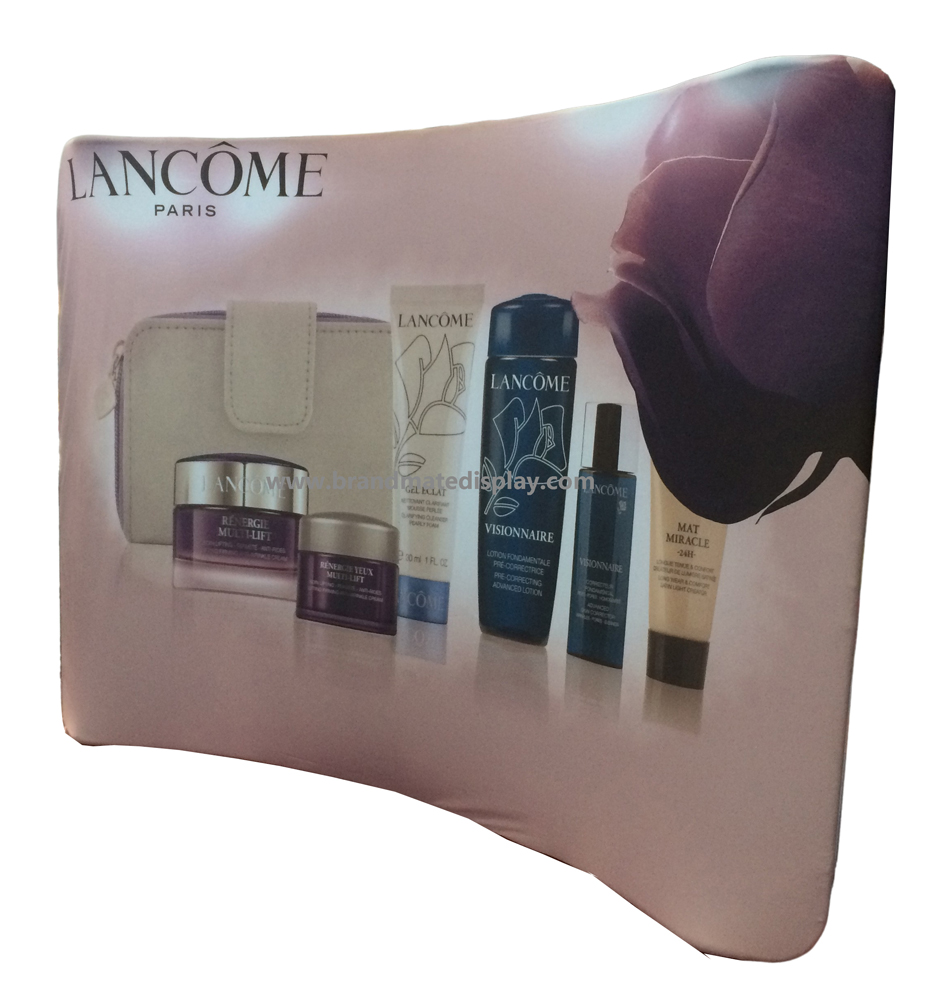
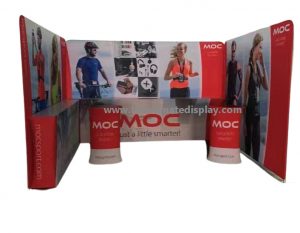
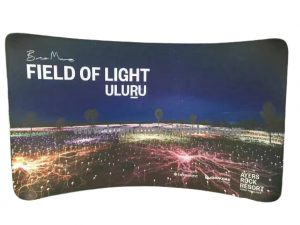
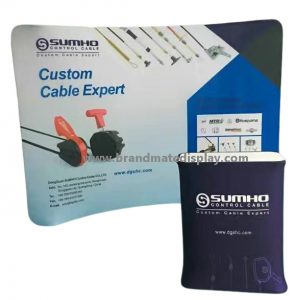
Backdrop Display: review the visual format, then ask for the frame drawing, graphic template and installation evidence for your proposed configuration. For a wider booth layout, review Exhibition Display and state which backwall, counter or other components you actually need.
BrandMate’s catalog is a starting point for that discussion, not proof that every photographed combination is available in every size. Ask us to confirm the offered configuration and quote scope. A useful supplier comparison is the completeness of the drawing, sample, acceptance plan and packing information returned for the same RFQ; this guide does not claim unverified superiority, certification or delivery performance.
No. Photocall names a photographic application; its structure may be an expanding frame, tube frame, panel or another specified system.
Yes. Fabric pop-ups exist. Confirm the actual expanding mechanism and graphic fixing rather than treating all pop-ups as magnetic-panel walls.
Only after compatibility is confirmed. Supply the hardware model and revision, installed dimensions, attachment details and approved template. Matching nominal width alone is not enough.
Test a fitted sample at the intended camera distance and lighting, with a person or object representing the subjects. Check logo legibility, cropping, visible seams and reflections in the resulting photographs.
An unconfirmed template, an incomplete hardware list, a failed fitted sample or a delivery plan that misses the venue cut-off. Resolve the specific gap before approving the next milestone.
Send your installed size, booth plan, quantity, graphic needs, destination and venue deadline through the contact page or the buttons below. Start with the main constraints; the simple form does not require you to know every technical answer.
For a custom size or specification, email BrandMate Display at [email protected] with your required width and height, booth or photography use, graphic requirements and any installation constraints. A sketch or venue photo is helpful. We can then discuss the appropriate configuration, artwork template and packing for your actual project.
Related: Quality Control · Warehouse & Logistics.
Request a configuration review