Address
Caochang Industrial Area, Liguang Rd, Lishui, Nanhai, Foshan, Guangdong, China
Phone:
0086-20-8938 9313
0086-757-8938 9313
Email:
Work Hours
Monday to Friday: 8AM - 10PM
24x7 online service

Address
Caochang Industrial Area, Liguang Rd, Lishui, Nanhai, Foshan, Guangdong, China
Phone:
0086-20-8938 9313
0086-757-8938 9313
Email:
Work Hours
Monday to Friday: 8AM - 10PM
24x7 online service
Custom LED Light Box & SEG Display Manufacturer
 Byadminn
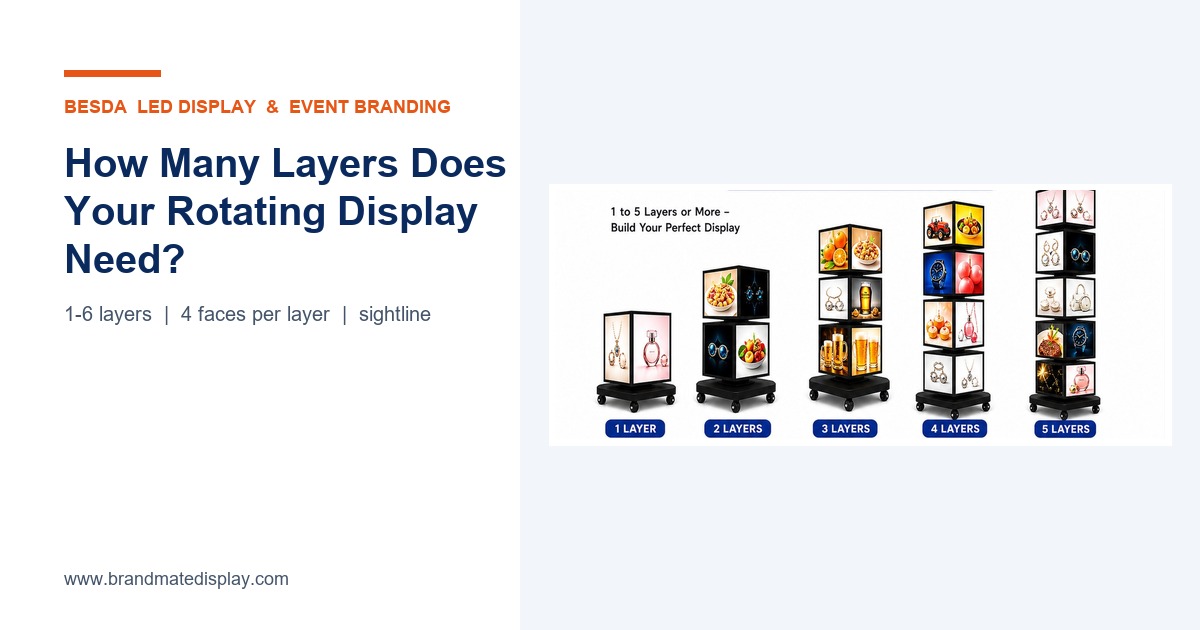
Rotating display layers set how many image faces a unit carries. Two to six layers show four faces each, a single-layer stand shows six, and a single-layer hanging unit shows five. Choose the count from your SKU list, then check it against ceiling height, sightline and weight.
A multi-layer rotating display is a stack of illuminated cube modules on a base plinth. Each module is one layer. A motor turns the stack, so every vertical face comes to the front in turn.
The layer count is the number that changes the whole order. It sets height, weight, total wattage, crate size and the number of artworks the buyer must supply. It also decides whether the unit is a rotating LED signage order that fits an existing ceiling or one that needs a site change.
Capacity follows a fixed pattern. Two to six layers each carry four image faces. A single layer works differently: six faces on a vertical stand, five when the unit hangs from a ceiling. Confirm the face layout on the drawing before artwork starts.
Layer count is display capacity for a given floor footprint. A three-layer unit keeps twelve faces in circulation. A six-layer unit keeps twenty-four.
Three consequences come with that capacity. The unit grows taller, heavier and hungrier for power.
Height ends projects. A six-layer unit on 400 mm faces stands around 3.0 m typical. Many retail ceilings sit between 2.7 m and 3.0 m before lights, ducts and sprinklers are counted.
The bottom layer is the second consequence. A face below 0.6 m is read by almost nobody, because trolleys, children and shelf ends block it.
The third sits in the quotation. Many quotes list layers and face size only. Ask for total height, weight and total wattage in the same document.
The arithmetic is short. Total height is close to base height plus layers multiplied by module height.
Module height is face size plus 50–80 mm of frame. A 400 mm face therefore makes a 0.45–0.48 m module. Base height runs 250–350 mm typical.
Worked example: 400 mm faces, a 350 mm base, a 50 mm frame. Each layer is 0.45 m, so a three-layer unit lands near 1.70 m and a six-layer unit near 3.05 m. Both are typical values. Confirm them on the general arrangement drawing.
The table below uses those assumptions and adds 0.3–0.5 m of working clearance for installation and graphic changes. Values are typical, not a product promise.
| Layers | Typical total height | Image faces | Ceiling to plan for |
|---|---|---|---|
| 1 | 0.75 m | 6 standing / 5 hanging | 1.10 m |
| 2 | 1.20 m | 8 | 1.60 m |
| 3 | 1.65 m | 12 | 2.05 m |
| 4 | 2.10 m | 16 | 2.50 m |
| 5 | 2.55 m | 20 | 2.95 m |
| 6 | 3.00 m | 24 | 3.40 m |
Weight follows height. A three-layer unit runs 30–45 kg typical, six layers run 70–90 kg. That decides whether casters are enough or the floor needs a load check.
Ask for braked casters on any mobile unit. An unbraked 80 kg column moves the moment a shopper leans on it.
For two to six layers the rule is slots = layers x 4. Four layers give sixteen faces. Five layers give twenty.
The single layer is the exception, at six faces standing and five hanging. Do not multiply that pattern upward. Take the face count from the drawing, not from arithmetic.
Rotation speed sets how long each face stays readable. Typical units run 1–4 rpm. With four faces a full turn takes 15 to 60 seconds, so each face holds the front for 60 divided by (rpm x 4), about 3.75–15 s.
A four-second front is a headline, not a paragraph. Plan eight to twelve words per face at that dwell time.
This is where layer count gets misjudged. Twenty-four faces at slow rotation still means a shopper sees four faces while standing there. More layers widen coverage. They do not raise attention per minute.
The same product in a different venue gets a different answer. Tailoring the unit to the site usually beats buying the largest model.
A supermarket aisle rewards four layers at 2.10 m. The unit reads over trolleys at the end of a run and stays below shelving signage.
A mall atrium rewards six layers. The extra metre buys legibility from fifteen metres, which is the distance an atrium works at. Hanging and floor-standing versions both exist, and the installation route should be chosen before the layer count is signed off.
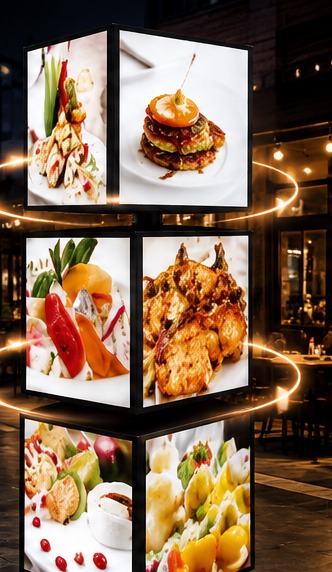
A restaurant host stand rewards two layers. Guests queue within 2 m, so a 1.20 m unit keeps faces at chest height where the queue looks.
An exhibition booth rewards three or four. The booth edge is crowded, and height above 2.2 m is wasted on a three-metre aisle.
Service access belongs in the same decision. Graphic change takes 1–3 minutes per face with a magnetic or pull-out frame. Twenty-four faces is roughly an hour of staff time per campaign.
| Spec | 1 layer | 3 layers | 6 layers |
|---|---|---|---|
| Image faces | 6 standing, 5 hanging | 12 | 24 |
| Typical total height | 0.75 m | 1.65 m | 3.00 m |
| Typical weight | single module, lightest | 30–45 kg | 70–90 kg |
| Power | 10–25 W per face | 100–250 W total typical | scales with face count, confirm nameplate |
| Best setting | counter, narrow aisle | aisle end, booth edge | atrium, tall lobby |
| Fails when | SKU list longer than 6 | ceiling under 2.05 m | ceiling under 3.40 m or no approval |
| Artworks to supply | 6 | 12 | 24 |
Fewer layers win in four situations:
Six layers is wrong in four others:
Two layers beat six whenever the shopper stands within 2 m. Height buys distance, not detail.
Send this list with the inquiry and the quotes come back comparable. The same fields are used on our technical specifications page.
| Item | Confirm on the drawing or nameplate |
|---|---|
| Layers and face size | exact count and face size in mm |
| Image slots | 4 per layer, or 6 / 5 for a single layer |
| Total height | base + layers x module, in mm |
| Base height | 250–350 mm typical |
| Weight | kg per unit, packed and unpacked |
| Power per face | W |
| Total rated power | W, plus voltage and plug type |
| Noise | dB(A) at 1 m, measured not estimated |
| Panel type | 3–5 mm acrylic, 4–5 mm tempered glass or PC |
| Graphic change | magnetic or pull-out frame, minutes per face |
| Casters | 50–75 mm swivel with brake |
| Packing | crate count, gross weight, CBM |
Layer count is a specification decision, not a style decision. Divide the SKU list by four, then check height, weight and wattage before anything is approved.
If the ceiling is tight, cut a layer. If the shopper stands close, cut two. Height only pays back when people read the unit from across a room, and printed faces carry that reading task better than a video screen in most shops.
Count the SKUs that must be visible at once and divide by four. Eight SKUs suit two layers, sixteen suit four, twenty-four suit six. Then check total height against the ceiling before ordering.
Yes at four faces per layer, which is the pattern for two to six layers. The faces turn in sequence, so a shopper sees four at a time. Confirm the layout on the drawing, because the single-layer version does not follow the four-face rule.
Around 1.65 m typical with a 400 mm face, a 350 mm base and a 50 mm frame. Larger faces and taller bases push it up. Ask for the height in millimetres on the drawing rather than a range.
One full turn takes 15 to 60 seconds at 1 to 4 rpm, so each of four faces holds the front for about 3.75 to 15 seconds. That suits a headline of eight to twelve words, not a paragraph.
Yes, and it then presents five image faces instead of six. Hanging versions need clear space below and a fixing point rated for the unit weight. Confirm both during the site survey.
Layer count, face size, total height, weight, total wattage, panel type, graphic change method and caster specification. A quote without those figures cannot be compared with another quote.
We will reply within 2 hours.
Prefer a form? Send the layer count, ceiling height and site photos below, or use the contact page.