Address
Caochang Industrial Area, Liguang Rd, Lishui, Nanhai, Foshan, Guangdong, China
Phone:
0086-20-8938 9313
0086-757-8938 9313
Email:
Work Hours
Monday to Friday: 8AM - 10PM
24x7 online service

Address
Caochang Industrial Area, Liguang Rd, Lishui, Nanhai, Foshan, Guangdong, China
Phone:
0086-20-8938 9313
0086-757-8938 9313
Email:
Work Hours
Monday to Friday: 8AM - 10PM
24x7 online service
Custom LED Light Box & SEG Display Manufacturer
 Byadminn
Exhibits move by luggage, by courier parcel or by pallet freight. Each is reliable within its limits and each fails in a different way: bags are lost, parcels are split and re-labelled, freight is held at a border or delayed at a dock.
Choosing per item rather than per booth is what keeps a display arriving complete. Panels and small hardware travel light; frames, counters and lighting travel heavy.
| Route | Best for | Main risk | Plan lead time |
|---|---|---|---|
| Carried luggage | Printed panels, table covers, small parts | Weight limits, crushed soft cases | Flight day |
| Courier parcel | One or two cases to a hotel or stand builder | Split shipments, missing signature | Three to five days |
| Pallet freight | Frames, counters, floors, lighting crates | Customs holds, dock windows, dock damage | Two to four weeks |
Handling is charged by weight and by unit count. Two cases that can be wheeled and stacked are easier to price than one awkward crate, and easier to find when a dock is busy.
Foam on the corners and a blanket over the face protect the printed panels, which are the least repairable part of any display. Corner damage on a rigid light box is a workshop job, not a tape job.
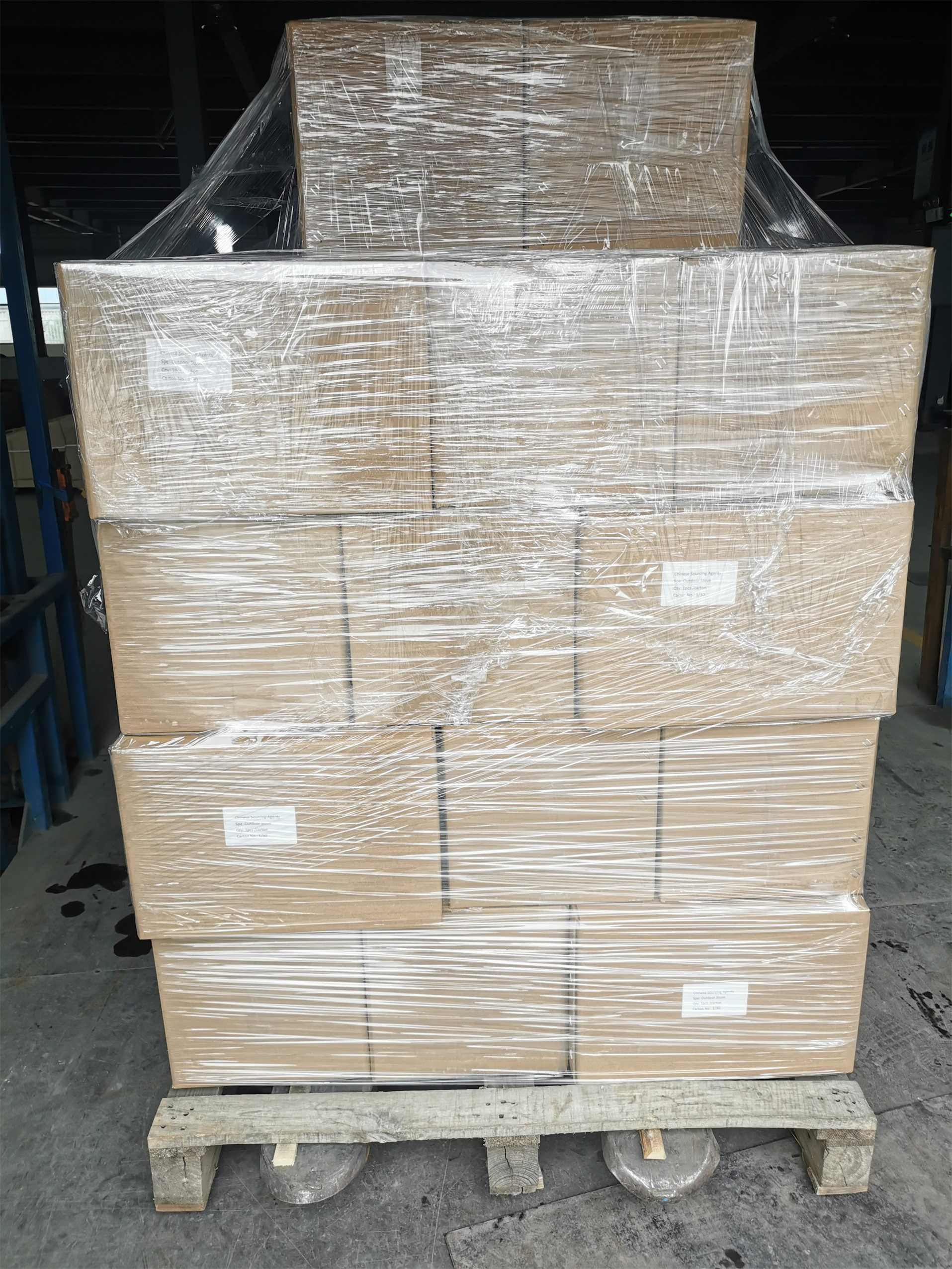
Labels go on two faces because stacks hide one side. Each carries the show name, the booth number, the company and a mobile number that will actually be answered during move-in.
Inside every case, a paper pack: packing list, spare parts list, a setup sheet and a photograph of the assembled booth. When a stranger opens a case, paper is the only instruction that survives.
Descriptions matter more than paperwork volume. A line that reads printed polyester display panel, exhibition use clears a customs query faster than display parts. Every document should carry the same booth number and show name so paper can be matched to pallet without a phone call.
One rolled spare panel, the artwork on two devices, a local print contact, a named receiving person and photographs at handover. That is the whole plan, and it turns a missing case into a same-day problem rather than a lost show.
Add a spares bag: hex keys, cable ties, gaffer tape, spare fixings and, for lit walls, one spare driver. Most on-site failures are small parts, not structures.
Shipping the only artwork file in the crate. Send the file before the crate leaves the workshop.
Booking freight before the display is packed. Dimensions and weights decide the freight class, and a re-measure at the dock produces a surcharge.
No buffer day. A shipment landing on the morning of move-in has no room for a re-sort.
Forgetting the return leg. Booking the way home from an empty hall costs more than booking it in advance.
Carried luggage and courier parcels. A fabric wall, printed counter and two stands fit into wheeled cases within typical limits, which avoids the pallet and the dock.
Show name, booth number, company name and a mobile number, on at least two faces, plus a case count such as one of four.
Two to four weeks for cross-border freight, with at least one working day of buffer before move-in.
Commercial invoice with specific descriptions, packing list with weights and dimensions, proforma where required, and the venue’s handling form.
A rolled spare panel and the artwork file carried on two devices. Both weigh almost nothing and cover the failure that stops a booth.
Work backwards from the first hour of move-in, not from the show date. Freight needs a dock appointment, a venue handling slot and a crew; each has a lead time and each can slip.
A practical sequence: pallet leaves the workshop four weeks out, clears customs three weeks out, arrives at the venue the day before move-in, and is placed in the first hour of the window. Every step gets a day of slack.
Cases that travel with a person skip most of that chain, which is why panels and small parts go in luggage while the frame goes on the pallet.
The way home is the step most exhibitors book last and pay most for. Book it before the show opens, confirm the collection window, and put the same labels on the cases for the return trip.
A booth that arrives home complete is a booth that can be checked, cleaned and stored straight away. One that trickles back in pieces tends to be discovered incomplete at the next show.
We will reply within 2 hours.
Prefer a form? Send the layer count, ceiling height and site photos below, or use the contact page.