Address
Caochang Industrial Area, Liguang Rd, Lishui, Nanhai, Foshan, Guangdong, China
Phone:
0086-20-8938 9313
0086-757-8938 9313
Email:
Work Hours
Monday to Friday: 8AM - 10PM
24x7 online service

Address
Caochang Industrial Area, Liguang Rd, Lishui, Nanhai, Foshan, Guangdong, China
Phone:
0086-20-8938 9313
0086-757-8938 9313
Email:
Work Hours
Monday to Friday: 8AM - 10PM
24x7 online service
Custom LED Light Box & SEG Display Manufacturer
Select a pavement A-frame only for a permitted location and conditions appropriate to the specific base, poster-retention method and site management plan.
For retail buyers and sign distributors, the useful approval is a matched package: a permitted site, the exact assembled frame with its graphics, and a daily handling and weather-response plan. Use this guide to gather the drawing, sample observations and local operating decisions needed before releasing a batch.
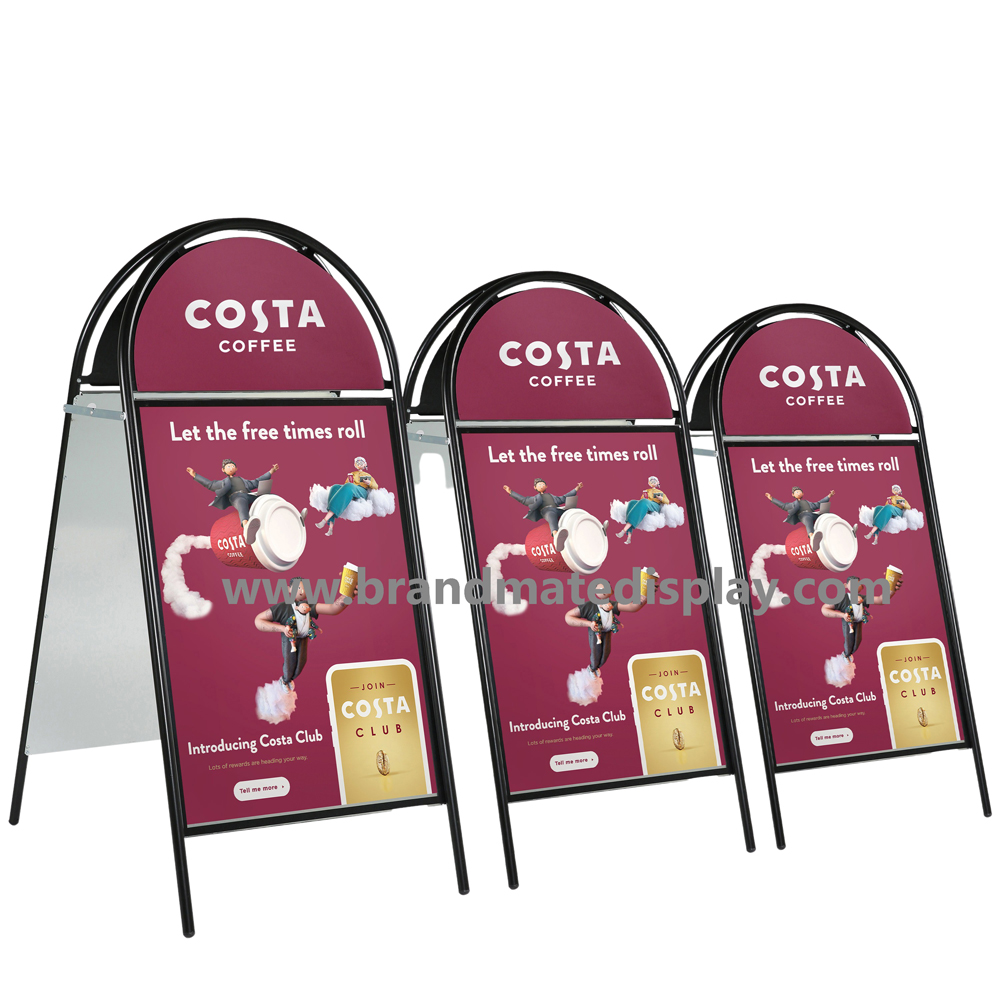
The BrandMate Pavement A Frame Poster Holder family photograph shows rounded-top folding poster stands and their projecting legs. Appearance alone does not establish the quoted material, installed mass, permitted wind exposure or weather protection. Match those details to the selected model and its instructions.
Confirm whether a freestanding promotional sign is allowed at the proposed location before choosing its size. The property manager and responsible local authority may set different conditions. Ask the site operator to identify the applicable permission, operating hours and restrictions for that exact position; a photograph of another shop is not placement approval.
Mark the intended position on a site plan with entrances, door swings, accessible routes, queues, deliveries and nearby vehicle sightlines. Measure the full open leg footprint, not just the poster width. Include handles, feet and any approved accessories that project beyond the printed face. Have the responsible site reviewer confirm the clear route using the rules that apply there rather than assuming one universal clearance.
Review the position during normal shop activity. A route that is clear before opening may later hold a queue or delivery trolley. Keep the sign out of required access and exit space and away from places where it obscures a driver’s or pedestrian’s view. Record a different approved position or choose another display approach if the location cannot accommodate the complete assembly.
Retain the approved plan and a photo showing the sign location in its surroundings. State who may move it and where it is stored when not in use. Permission for one branch or one frontage does not automatically authorize the same layout across every store.
Request a drawing showing overall open dimensions, leg spread, folded thickness and the exact print cut size and visible area. For a rounded header, confirm whether the curved graphic is a separate insert and how it is retained. A nominal paper-size label or a flat-top drawing cannot settle the opening geometry of a different frame.
Use the intended print and protective face, if offered, in the sample. Check that each insert fits its stops, remains flat and stays retained through the maker’s normal opening and closing sequence. Confirm front and rear artwork requirements separately. A loose edge, curled corner or cover that will not close calls for a corrected template or retention detail before bulk printing.
Compare the complete model’s material, finish and assembled mass with the offer. A metal name alone does not describe stability, corrosion protection or daily carrying effort. If steel and aluminum configurations are proposed, compare the actual assemblies and care instructions rather than assigning either metal a universal outdoor advantage.
Show the maker the proposed surface and any slope, joints or uneven paving. Identify the actual feet or pads included in the quotation and the surfaces for which they are intended. A sample on a smooth indoor floor does not establish grip on wet or uneven paving. If a foot does not sit as intended, keep placement open for a revised location or maker-approved configuration; do not level the frame with improvised objects.
| Decision | Evidence to obtain | Keep open when |
|---|---|---|
| Permitted position | Site plan, responsible operator, applicable permission and operating conditions. | The frontage, operating hours or responsible approver is unresolved. |
| Full footprint | Open leg outline, projections, door/queue/delivery positions and local route review. | The drawing shows only poster width or conflicts with the approved route. |
| Graphic assembly | Print cut size, visible area, header shape, covers and retention method for the exact model. | Artwork is based on another profile or the loaded face cannot close and retain correctly. |
| Ground contact | Actual surface condition, included feet/pads and the maker’s placement instructions. | A foot does not sit as intended or the surface falls outside the proposed use. |
| Exposure and handling | Model-specific use limits, approved accessories, carrying method and staff withdrawal plan. | Outdoor suitability is assumed from weight, a photograph or a generic product label. |
Ask for a representative finished sample matching the quoted drawing and components. In a controlled area away from the public, assemble it according to the instructions and fit both intended posters and covers. Identify the sample and record the drawing revision so later photographs cannot be confused with another size or model.
Check hinges, pivots, fasteners and any chain, brace or opening restraint actually used by that design. Confirm how the intended open position is established and whether any lock must engage. Follow the instructed sequence and keep hands clear of folding and pinch areas. A chain visible in a photograph is not proof of a locking function, and an unfamiliar restraint needs clarification before use.
Inspect squareness, joints, exposed edges, frame closure and the contact points at each foot. Record looseness, distortion, sharp damage or unexpected spreading. Photograph the whole assembly and the affected detail, then request a corrected sample or an approved repair instruction. Keep the sample out of public service until the responsible reviewer closes the issue.
Agree any stability assessment with the maker and a competent site reviewer for the exact frame, poster area, ground and proposed exposure. Do not improvise a push, gust, tilt or hanging-weight test as proof of a safe wind limit. A normal assembly and function check records what was inspected; it does not create a wind rating or approve untested conditions.
Wind can act on the printed face while the base must resist both sliding and overturning. Ask what outdoor conditions the offered assembly is intended for and what evidence supports any stated limit. The relevant record must identify configuration, poster area, surface, method and conditions. A heavier-looking frame or another size’s test is not enough to extend that limit.
Use extra ballast or an anchoring accessory only when its method, amount, attachment and placement are approved for the selected model and site. Confirm how the accessory affects the footprint, carrying method and route clearance. Hanging a weight from a crossbar or adding a loose object may change the assembly in an unassessed way; request the designed arrangement instead.
Review rain exposure separately from stability. A clear poster cover does not by itself establish a waterproof assembly. Confirm the permitted environment, print media, cover/edge details and any drainage provision in the offered model. Ask how to dry and store it after permitted exposure. Do not add drainage holes, sealants or a different cover without an approved revision.
The site operator should set a withdrawal procedure consistent with the model’s instructions and local conditions: who monitors conditions, who moves the sign, when it is brought inside and where it is secured. Keep use unresolved if the proposed exposure has no supported limit or practical staff response. Staff should not wait for visible sliding or overturning to decide how to act.
Have the intended operator review the maker’s poster-change and folding sequence on the representative sample in a controlled area. Check access to each face, the way covers and corners close, and where hands need to be placed. Agree a corrected component or clearer instruction if the graphic catches, a closure remains open or the normal sequence is unclear.
Confirm the complete loaded weight, intended carrying points, folded dimensions and the proposed route to storage. Review the task with the people who will perform it; a compact folded photograph does not show whether the assembly fits through the actual doorway or can be handled appropriately. Use the instructed number of people or handling aid where required. Do not drag the legs or lift by an unapproved chain or poster cover.
Inspect finish coverage and contact areas around the feet, pivots and folding joints. Record any chipped coating or exposed damage and ask for the model’s approved care and repair method. Protective pads can require replacement; identify the correct part rather than assuming any adhesive pad has the same fit or grip.
Agree how posters, covers, hinges and legs are protected during delivery and daily storage. Secure loose items and prevent frames rubbing or twisting according to the packing plan. Check incoming pieces for damage before allocating them to sites. A receiving record should identify the affected part and unit, with photos and an agreed remedy rather than silently moving a damaged frame into service.
Separate the buyer’s product approval from the operator’s location approval. The purchasing team records the exact frame, graphics, components, finish and drawing revision; the responsible site reviewer closes placement and operating conditions. Both records need to describe the configuration that will actually arrive. A sample accepted at one site is not automatic approval for a different surface or exposure.
Use a clear result for each check: approved for the recorded conditions, awaiting a specified correction, or not approved. Retain the sample ID, dated photos, instructions, unresolved items and reviewer/date. For a defect, identify the affected requirement and request a corrected sample or documented remedy; repeat the affected checks before closing it.
Give each branch the approved position, normal opening/closing and poster-change instructions, withdrawal procedure and inspection responsibility. Check the frame and route before use and as conditions require. Damage, looseness, unexpected movement or a blocked route calls for withdrawal and review, not automatic reuse after moving the sign a few steps.
For repeat orders, compare current model, drawing, feet, restraints, covers and artwork geometry with the retained record. Review a changed poster area, accessory, surface or location as a new condition. Record which checks must be repeated and who authorizes the updated release.
| Stage | Retain | If unresolved | Closure |
|---|---|---|---|
| Configuration | Offer/drawing revision, model, loaded graphics, cover, feet and included restraints. | Identify a missing or substituted component. | Matching revised offer and representative sample. |
| Assembly and changeover | Instructed open position, hinges/closure/retention observations and dated photos. | Withdraw a damaged, loose or unclear assembly from use. | Approved correction and repeated affected checks. |
| Site placement | Permission, full footprint, surface, clear routes and responsible site reviewer. | Keep deployment open; identify a revised location or configuration. | Site-specific approval for the documented position. |
| Operating handover | Use limits, carrying/storage method, inspection owner and weather-withdrawal procedure. | Do not substitute a generic outdoor label for missing instructions. | Confirmed model instructions and workable site responsibilities. |
| Repeat order | Retained sample and current component/drawing/site comparison. | List changed parts, artwork area or conditions. | Reviewed changes and the required repeated checks. |
For a configuration discussion, send poster cut size and orientation, any rounded-header requirement, proposed location photos, full available footprint, ground surface, exposure conditions, quantity and destination. Include the permission constraints and daily handling or storage needs. Ask for a model-specific drawing, included components, use instructions and representative sample plan; the offered specification and supply terms need confirmation for your project.
No. Ask for the limit and evidence for the exact assembled model and its stated conditions, then have the site reviewer assess the intended placement and operating response. Mass alone does not approve wind exposure or surface grip.
A cover alone does not establish that. Confirm the complete model’s stated environmental limitations, poster media and any drainage/care provisions before approving rain exposure.
Keep the product record consistent, then review each branch’s permission, full footprint, surface, exposure and staff handling. A different site condition can require a revised configuration or another placement decision.
Explore the BrandMate Pavement A Frame Poster Holder family and bring the unresolved site or assembly decisions to your first inquiry.
Tell BrandMate the intended poster and location. Drawings, site photos and detailed approval records can follow the initial discussion.