Address
Caochang Industrial Area, Liguang Rd, Lishui, Nanhai, Foshan, Guangdong, China
Phone:
0086-20-8938 9313
0086-757-8938 9313
Email:
Work Hours
Monday to Friday: 8AM - 10PM
24x7 online service

Address
Caochang Industrial Area, Liguang Rd, Lishui, Nanhai, Foshan, Guangdong, China
Phone:
0086-20-8938 9313
0086-757-8938 9313
Email:
Work Hours
Monday to Friday: 8AM - 10PM
24x7 online service
Custom LED Light Box & SEG Display Manufacturer
 Byadminn
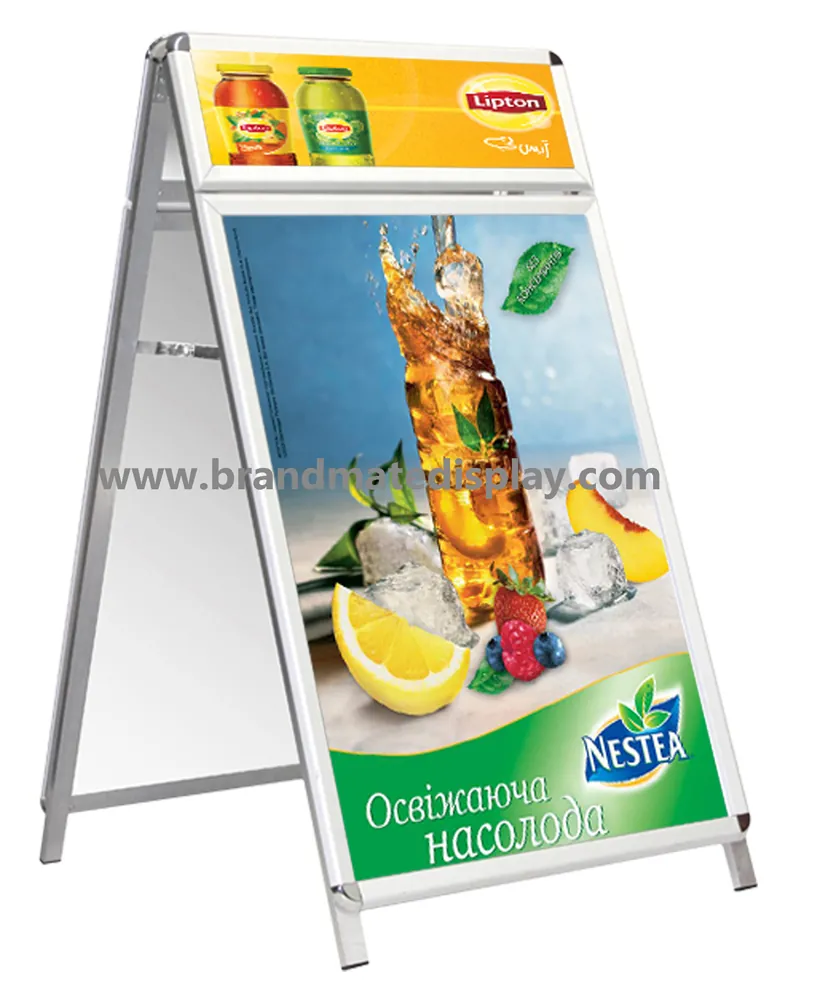
Two panels joined at a hinge present a flat surface to moving air. Wind force rises with the square of speed, so a breeze that feels harmless doubles its force when the speed doubles, and a light frame has almost no lever to resist it.
Stability comes from three things working together: weight at the bottom, a footprint wide enough to resist tipping, and a hinge that locks the two panels into a rigid triangle.
Weight belongs in the base bar or in the feet. Hanging a bag on the crossbar raises the centre of gravity and makes tipping easier, which is the opposite of what the sign needs.
| Condition | Working ballast | Action |
|---|---|---|
| Sheltered doorway, light breeze | Frame weight, at the base | Sign stays out daily |
| High street, 20-30 km/h | Double the frame weight | Move closer to the wall |
| Exposed corner or forecourt | Heavy base or steel frame | Add ground anchor |
| Above 30 km/h sustained | Not applicable | Bring the sign inside |
Sand is heavier per litre than water and does not freeze; water is easier to empty at closing time. Both beat an improvised brick on the crossbar.
A hinge that merely resists lets the A flatten slightly under load. The top widens, the footprint narrows, and the sign starts to rock. A positive lock holds the angle and keeps the base where it was set.
Test it by pushing the top panel sideways. A rigid triangle resists; a loose hinge folds and the feet lift on one side.
Hard plastic feet slide on wet paving before the sign tips. Rubber with a small lip grips, and a hole or ring in each foot allows an anchor on exposed sites.
Surface matters as much as the foot. Polished entrance paving, metal grates and wet tiles all reduce grip, and the same sign that holds on asphalt will travel on a ramp.
Behind the shop line. Private forecourt near the window sees less wind and stays out of the pedestrian flow.
Against a return wall. A sign with its back near a wall cannot fall far, and the wall breaks the gust.
Clear of the walking line. A sign that forces people to step around it generates complaints, and in many places a removal notice.
Clear of the kerb. The gutter collects spray, car doors and enforcement attention.
Pavement display is regulated almost everywhere and the rules vary by street. Some places allow one sign per frontage up to a set size; others require a licence, insurance and a marked position.
Photograph the sign in place with a tape measure visible, then check the local code once a year. Keep the sign smaller than the walking route and on your own frontage, and the conversation with enforcement stays short.
1. Push the top sideways and watch the feet.
2. Ask for the base weight empty and filled.
3. Check the hinge locks positively.
4. Confirm the feet are rubber with a lip.
5. Check the insert is sealed against rain.
6. Confirm an anchor point exists for exposed sites.
At least the weight of the frame and panels together, preferably double, and always at the base rather than on the crossbar.
Usually a hinge that does not lock, weight placed too high, or a position where wind funnels between buildings.
On private forecourt close to the shop line, with a clear pedestrian path, and never in the gutter or blocking the kerb.
Above roughly 30 km/h of sustained wind, and every night unless the position is sheltered.
Weight helps at the base. A heavy sign with a loose hinge and hard plastic feet still slides and folds in wind.
At opening, place the sign, check the hinge lock and confirm the ballast is touching the base. At closing, bring it in or anchor it, because wind at night is often stronger and nobody is watching.
A thirty-second routine at each end of the day prevents most of the damage these signs suffer, and it also keeps the sign in the permitted position rather than drifting into the walking line.
Replace when the hinge no longer locks, when the frame is out of square, or when the feet have worn smooth. Those three faults turn a stable sign into a sail, and none of them is fixed by adding weight.
We will reply within 2 hours.
Prefer a form? Send the layer count, ceiling height and site photos below, or use the contact page.