Address
Caochang Industrial Area, Liguang Rd, Lishui, Nanhai, Foshan, Guangdong, China
Phone:
0086-20-8938 9313
0086-757-8938 9313
Email:
Work Hours
Monday to Friday: 8AM - 10PM
24x7 online service

Address
Caochang Industrial Area, Liguang Rd, Lishui, Nanhai, Foshan, Guangdong, China
Phone:
0086-20-8938 9313
0086-757-8938 9313
Email:
Work Hours
Monday to Friday: 8AM - 10PM
24x7 online service
Custom LED Light Box & SEG Display Manufacturer
 Byadminn
Crystal light box acrylic thickness decides three things a buyer feels every day: how stiff the panel is, how evenly the edge light spreads, and how the unit handles in cleaning and transport. This guide covers the thickness choices, what edge polishing does, how glare is controlled, and the spec lines to fix before ordering.
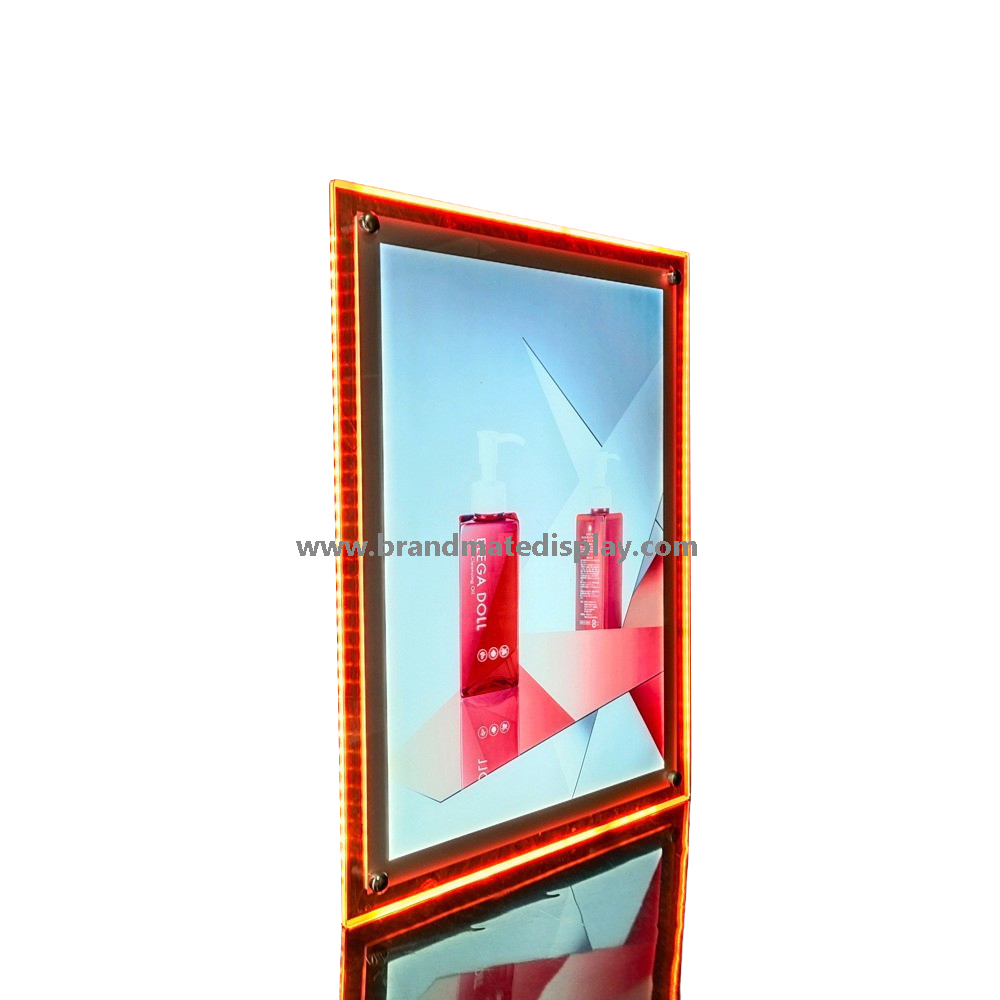
A crystal light box is a clear acrylic panel set on standoffs or a minimal base, lit from the edges so the whole sheet reads as one glowing plane. There is no visible frame; the acrylic is the structure and the look at the same time.
That is why thickness is not a detail here. In a framed box the frame carries the load; in a crystal display the panel itself does. Thickness sets stiffness, light spread and weight in one decision.
Three failures trace straight back to a panel chosen too thin. The plate bows and shows reflections in waves. The edge glow dies halfway across a large sheet. Corners chip on the first cleaning round.
Thickness also decides the weight a standoff must carry. A thin panel on wide standoffs flexes at the corners; the fix is more fixing points or a thicker sheet, and both belong in the drawing rather than on site.
The honest framing for the buyer: thicker is not automatically better. Thick panels add weight and budget, and can spread light unevenly if the engraving or diffuser is not matched. The right thickness is matched to the panel size and the lighting plan.
Edge-lit acrylic works on total internal reflection: LEDs fire light into the polished edge, the sheet guides it, and engraved or printed dots extract it toward the graphic. Thickness changes the guide’s geometry.
A thin sheet extracts light quickly and suits small panels. A thicker sheet gives the light more travel room, which large panels need to stay even from edge to centre. This is the same uniformity question every light box answers, only on a clear stage where a dark corner is visible to everyone. Our technical specifications page lists the uniformity and CRI criteria to put in the order.
Colour temperature sits in the same decision. Warm CCT flatters food and wood tones; neutral CCT suits retail colour checks, as the CCT and CRI guide explains for shopfloor cases.
| Aspect | Crystal display | Framed acrylic box |
|---|---|---|
| Structure | panel on standoffs or base | frame carries the panel |
| Look | frameless, glass-like | defined border |
| Thickness role | structural: the panel is the body | less critical: the frame carries load |
| Edge role | polished edges are the light entry | edges hidden in the frame |
| Cleaning | panel surface only | frame and panel |
| Best for | premium, photo-facing settings | high-traffic functional signage |
Thickness is a structural and optical choice; polish is a surface choice. Buyers who merge them accept a quote line they cannot judge.
Polishing decides how the edge looks and how cleanly it accepts light. A flame-polished edge reads glossy and smooth; a diamond-polished edge is flatter and crisper. Either is legitimate; the failure is an unpolished or scratched edge, which scatters light and shows as a dull band in the glow.
Inspect both on the sample, exactly as the edge finish sample guide walks through: edges and corners under light, reflections at working angles, and the fixing details.
| Situation | Verdict | Why |
|---|---|---|
| Premium counter or jewellery setting | Worth it | The frameless look is the value |
| High-traffic corridor at elbow height | SKIP it | Framed or magnetic fronts take knocks better |
| Large panel with no engineering input | SKIP until drawn | Thickness, stiffness and fixings need a drawing |
| Outdoor or humid position | SKIP it | This is an indoor product; confirm IP with the supplier |
| Frequent graphic changes | Risky | Confirm the access method; crystal is not a quick-change front |
| Feature wall with power nearby | Worth it | Standoff mounting shows the glow at its best |
Send this with the RFQ; every line is answerable with a number or a named process.
| Field | Confirm |
|---|---|
| Panel size | mm per unit |
| Acrylic thickness | mm, matched to size and lighting plan |
| Light guide method | engraving or diffuser, per size |
| Uniformity target | checkable figure, measured with graphic fitted |
| CCT and CRI | per the retail colour guide |
| Edge finish | flame or diamond polish, all edges |
| Standoffs | count and spread for the panel weight |
| Graphic surface | matte print or film spec |
| Cleaning method | documented, acrylic-safe |
Thickness also changes the handling story. A thicker large panel is heavier, which pushes the standoff size up and the packing crate with it. Ask for the panel weight with the spec; it decides whether one installer can mount it or the wall day needs two.
Transport punishes unprotected acrylic corners. The packing spec belongs in the same conversation as the thickness: foam edges, protective film kept on until mounting, and a crate the panel cannot slide in. Our packaging team packs crystal panels film-on with corner protection as standard; confirm the detail with your order.
Thickness scales with panel size and the lighting plan: small panels run on thinner sheets, large panels need thicker stock so the glow stays even and the plate stays flat. There is no single right figure; ask the supplier which thickness their uniformity target assumes for your size.
The polished edge is the light’s entrance. Flame or diamond polish leaves the surface smooth so light enters cleanly; an unpolished or scratched edge scatters it, which reads as a dull band or a dark patch in the glow.
Work the graphic surface and the position: matte prints and films reflect less than gloss, and mounting away from facing windows removes the mirror effect. Raw brightness is the weak lever; surface and angle are the strong ones.
No. Thickness changes the guide geometry, not the brightness by itself. A large thin panel may glow unevenly, while an over-thick small panel can extract light oddly. Match thickness to size and light guide design, then judge uniformity with the graphic fitted.
Acrylic-safe cleaner and a soft cloth, never dry rubbing, and no ammonia products. The panel is the whole look; a scratch in the surface is permanent and shows in the glow.
Edges and corners under light, reflections at the working angles, uniformity with the graphic fitted, the standoff fixing detail and the packing protection. The edge finish sample guide lists the full sequence.
Crystal light box acrylic thickness is a structural and optical decision in one: it sets stiffness, glow spread and weight. Edge polish and graphic surface decide whether the result reads premium or cheap.
Specify thickness against panel size, demand a polished edge on all four sides, answer glare at the artwork stage, and prove it all on one sample before the batch. The crystal display product page lists sizes and RFQ fields, and the SEG vs acrylic comparison covers the framed alternative for retail windows.
We will reply within 2 hours.
Prefer a form? Send the layer count, ceiling height and site photos below, or use the contact page.