Address
Caochang Industrial Area, Liguang Rd, Lishui, Nanhai, Foshan, Guangdong, China
Phone:
0086-20-8938 9313
0086-757-8938 9313
Email:
Work Hours
Monday to Friday: 8AM - 10PM
24x7 online service

Address
Caochang Industrial Area, Liguang Rd, Lishui, Nanhai, Foshan, Guangdong, China
Phone:
0086-20-8938 9313
0086-757-8938 9313
Email:
Work Hours
Monday to Friday: 8AM - 10PM
24x7 online service
Custom LED Light Box & SEG Display Manufacturer
 Byadminn
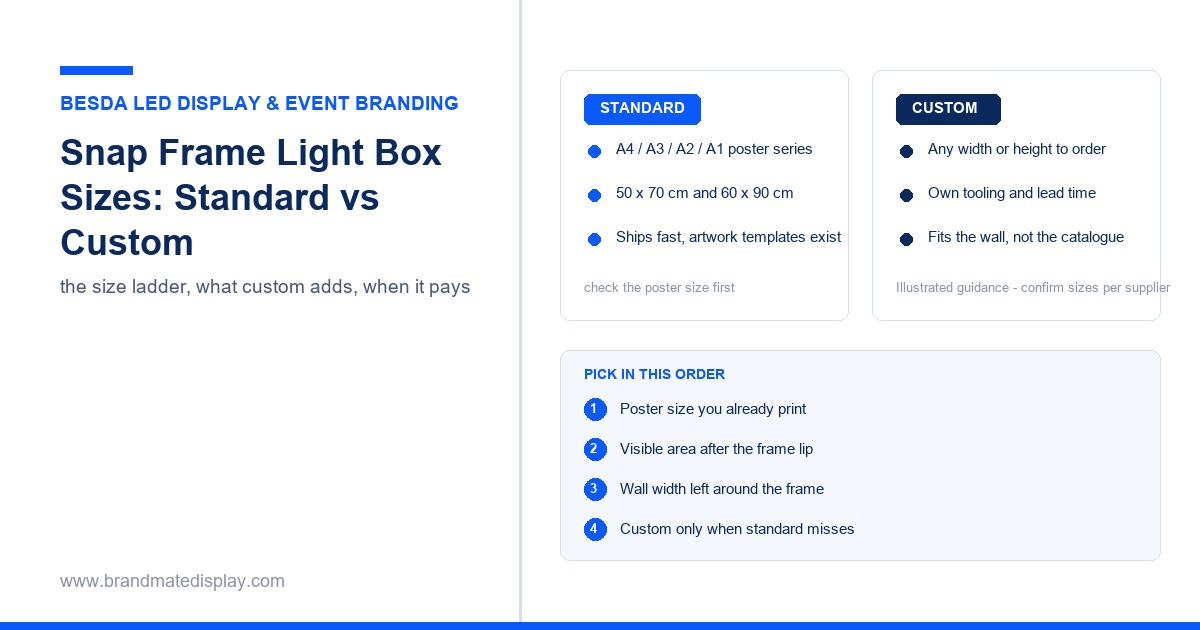
Snap frame light box sizes follow the poster, not the other way round. Standard frames match the common poster series, ship fast and have ready artwork templates. Custom sizes fit a specific wall or layout and trade speed for fit. This guide walks the size ladder, what custom actually adds, and a four-step picking order that ends the argument.
Three dimensions live inside one snap frame light box, and buyers who merge them order the wrong frame. The poster size, the visible area inside the frame lips and the overall frame outline all differ.
Standard sizes are built around the poster series most shops already print. Custom sizes start from the wall or the layout instead. Both exist because lighting profiles are extruded to length; once the profile exists, cutting it to a non-standard width is a manufacturing question, not a miracle.
Size drives three costs that grow quietly. Larger faces need brighter or more evenly spaced LEDs, which the technical specifications page turns into checkable numbers. Larger crates change the freight calculation. And non-standard sizes give up the shelf: templates, spare frames and reorder speed all live on the standard ladder.
The ladder also decides artwork. A standard frame means your designer downloads a template and fits content inside the visible area. A custom frame means the dieline comes after the frame drawing, which is why the poster size and visible area guide insists the three dimensions stay separate on paper.
Most suppliers stock the A-series first: A4, A3, A2 and A1, in portrait and horizontal formats. These match office printers and the poster stock every print shop keeps, so replacement posters are a same-day errand.
Next come the display formats that grew out of retail: mid-size posters such as 50 x 70 cm and 60 x 90 cm, and slim horizontal formats for menu strips and shelf headers. Availability differs by supplier; confirm per project before promising a size to your own customer.
The frame profile itself is a separate choice: the same poster size exists in slim profiles for tight walls and deeper profiles for more presence. Depth does not change the poster; it changes the look and the light laydown.
| Aspect | Standard sizes | Custom sizes |
|---|---|---|
| Starting point | the poster series you print | the wall or layout you have |
| Tooling | none, profiles already extruded | cut-to-length or new profile per order |
| Artwork | templates exist for the visible area | dieline drawn after the frame drawing |
| Reorder speed | fast, stock-dependent | runs the frame path again |
| Spare parts | matching frames on the shelf | keep one spare per size |
| Freight | standard crate maths | crate sized to the frame |
| Best for | chains, replacements, tight dates | feature walls, unusual layouts |
A custom frame is a different width or height cut from an existing profile. An oversize frame crosses into engineering: larger panels need stiffer backing, more support points and a lighting plan of their own.
Buyers who merge the two get surprised twice. A “custom” A-series ratio frame ships almost as fast as stock. A two-metre-wide snap frame carries real structural questions, and the honest supplier answers them before quoting. Ask which one you are buying.
| Situation | Verdict | Why |
|---|---|---|
| Poster series already fixed | SKIP custom | Standard frame matches; custom adds nothing |
| Feature wall with a set alcove | Custom pays | The wall is the specification |
| Chain rollout, many sites | SKIP custom | One standard size copies across sites |
| Non-standard ratio campaign graphic | Custom pays | Forcing it into a standard lip crops content |
| One-off event, one use | SKIP custom | Rental or modular backwalls fit better |
| Slim horizontal strip above a counter | Usually custom | Menu strips rarely match A-series ratios |
The frame does not hang in a catalogue; it hangs in a room. Height decides whether the top lip can be opened for a change without a ladder, which matters more on an A1 frame than on an A4.
Viewing distance decides the useful size. A 60 x 90 cm poster reads across a shop floor; the same sheet beside a counter is overkill, and an A4 at fifteen metres is decoration.
Neighbours decide the profile. A new frame joining a wall of existing frames should match their depth, or the wall reads as two installations. Note what is already mounted before picking from the ladder.
None of these three checks adds a single millimetre to the frame. They decide whether the size you picked does the job you bought it for, which is the whole point of keeping the ladder separate from the wall.
Send this with the inquiry and the quote comes back checkable.
| Field | Confirm |
|---|---|
| Poster size in use | mm, portrait or horizontal |
| Visible area needed | mm inside the lips |
| Frame outline allowed | mm, wall width minus clearance |
| Profile depth | slim or standard, match other frames on site |
| Standard or custom | and if custom, cut-to-length or new profile |
| Change frequency | who changes, how high the top edge sits |
| Quantity | per size, per site |
| Packing | crate orientation for the largest frame |
The standard ladder follows the poster series: A4, A3, A2 and A1, plus common display formats such as 50 x 70 cm and 60 x 90 cm, with slim horizontal variants for menu strips. Anything outside that is custom, cut to length from the same profiles; confirm current stock sizes per supplier.
A cut-to-length frame from an existing profile usually runs close to standard timing. A frame that needs a new profile, or an oversize that adds structural backing, runs the full custom path with samples. Ask the supplier which case your size falls into.
No. The frame lips cover the poster’s outer band, so the visible area is always smaller than the paper. Design essential content inside the closed-frame view; the exact figures sit in the poster size and visible area guide.
Standard, unless a specific site forces otherwise. One size across stores means one artwork template, one spare-frame policy and one freight plan. A single custom size multiplies all three.
Widths are cut from extruded profiles, so a wide range is possible. Past roughly a metre, expect the quote to include stiffer backing and more support points, because the panel and lips carry real load. Confirm per project with the frame drawing.
The poster size, the visible area the artwork needs, the wall clearance, the profile depth to match nearby frames, and the quantity per size. Those five lines turn a catalogue question into a quotation.
Snap frame light box sizes start from the poster you already print. Standard sizes win on speed, spares and chain logic; custom exists for walls and layouts the ladder cannot reach.
Run the four steps, keep the three dimensions separate, and the frame choice makes itself. The snap frame product page lists the range and RFQ fields, and the crystal display page covers the frameless alternative.
We will reply within 2 hours.
Prefer a form? Send the layer count, ceiling height and site photos below, or use the contact page.