Address
Caochang Industrial Area, Liguang Rd, Lishui, Nanhai, Foshan, Guangdong, China
Phone:
0086-20-8938 9313
0086-757-8938 9313
Email:
Work Hours
Monday to Friday: 8AM - 10PM
24x7 online service

Address
Caochang Industrial Area, Liguang Rd, Lishui, Nanhai, Foshan, Guangdong, China
Phone:
0086-20-8938 9313
0086-757-8938 9313
Email:
Work Hours
Monday to Friday: 8AM - 10PM
24x7 online service
Custom LED Light Box & SEG Display Manufacturer
 Byadminn
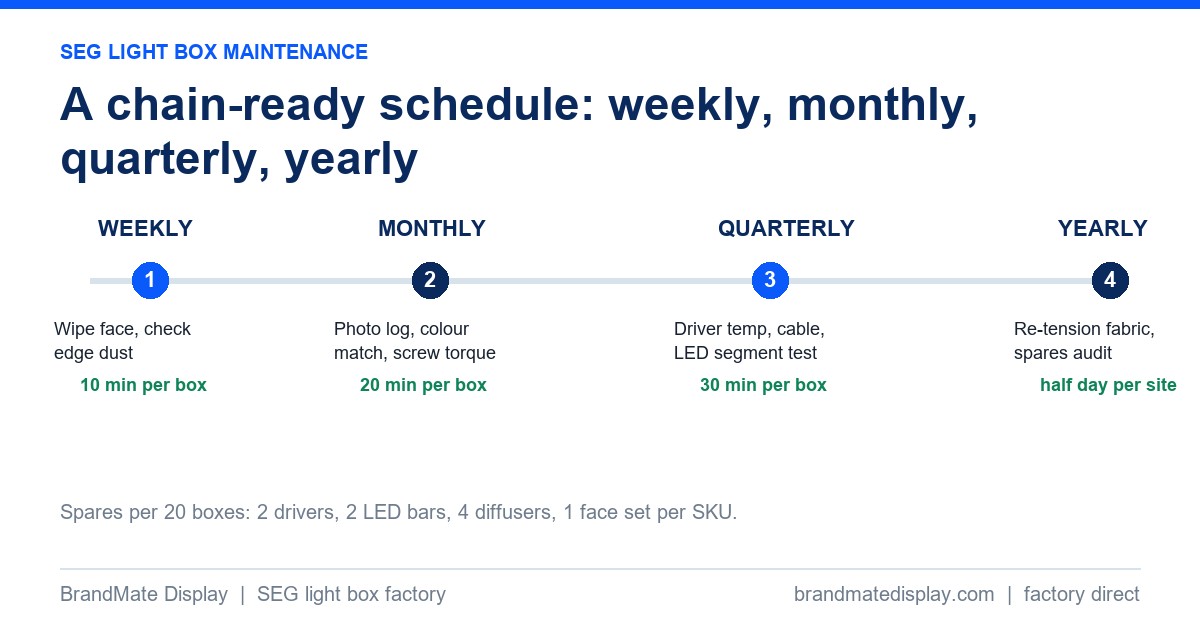
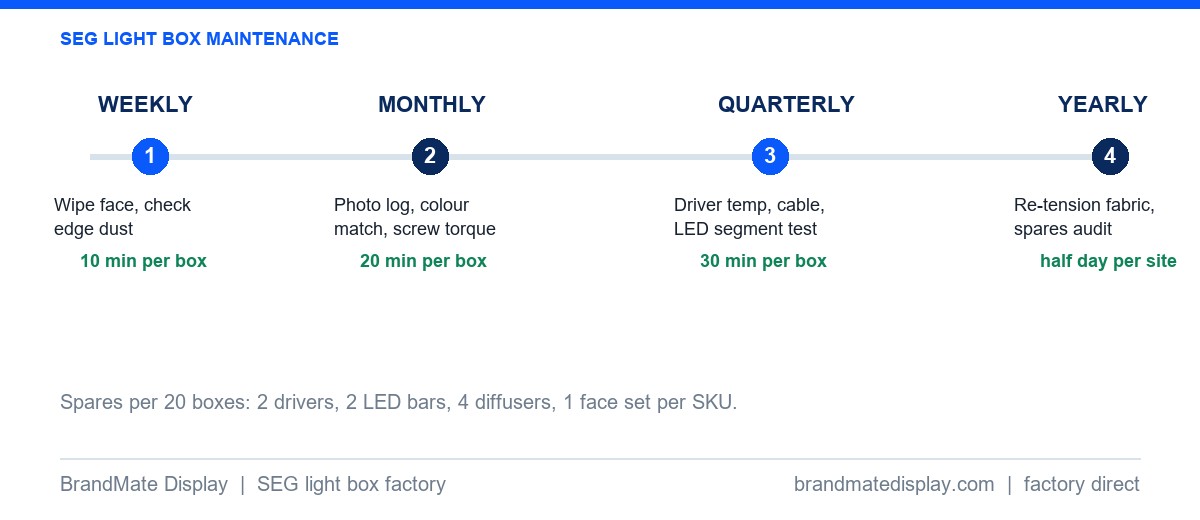
SEG light box maintenance is a scheduled job, not a repair response. A workable schedule names who cleans each face, when output is measured, and which spares sit in the stockroom. Chains need one schedule across every site, because a face that looks correct at handover can drift gray long before anyone reports it.
A SEG light box maintenance schedule is a written cycle of cleaning, inspection and parts replacement for every illuminated face in a store estate. It names the task, the interval, the person and the record.
It is not a cleaning rota pinned to a staffroom wall. A rota covers dust. A schedule also covers LED output, driver condition, fabric tension and the batch codes of replacement modules.
The unit of work is the face, not the store. A store with four double-sided units carries eight faces. Each face has its own install date, batch code and light reading.
One gray face in one store is a maintenance ticket. The same fault in forty stores is a brand problem, and it shows up in photos taken by customers.
Light output falls before it fails. A module at 70% of its first-day output still lights, and staff stop noticing. A recorded reading is the only thing that catches the drift.
Spare parts decide downtime. A driver swap takes minutes when the spare sits in the stockroom and matches the load. It takes a purchase order and a wait when nobody wrote the batch code down.
Chain buying adds one more risk: inconsistency. Two sites serviced on different cycles can show visibly different brightness on the same 4000K setting.
Three tiers keep the workload proportional. Store staff handle what needs no tools. An area technician handles what needs a meter. An electrician handles what needs the supply isolated.
The weekly check is a visual sweep. Look for dark segments, wrinkles, dust along the top edge and a face that has lifted from the groove. Budget 30 seconds per face.
The quarterly service adds measurement. Clean the face, read nine points with a lux meter, and log the average and the minimum. A good unit holds 85-95% min-to-max, and a slide toward 60-70% points to a module or diffuser fault. Check the driver for heat marks and the cable for strain.
The annual service is electrical. Isolate the circuit, check earth continuity, look for discolored terminals and record the driver label date. A shallow 30 mm frame traps heat closer to the LEDs, so that check matters more there; the frame depth guide compares 30, 50 and 80 mm.
Every tier writes to the same log: site ID, unit ID, face size, clean date, lux reading, part fitted, batch code and one photo. A schedule without records cannot prove that a site was serviced.
A mall unit runs long hours under air handling that moves dust. The top edge of the frame collects a gray line that shows in photos and in the mall’s own walk-throughs.
A high ceiling changes access. A face at 4 m needs a lift and a permit, so the clean interval stretches and each visit covers more checks. The wall mounting guide covers the fixing side.
A convenience store trading around the clock cannot isolate power in daylight. Servicing moves to a night window, and the schedule must name that window and the person who holds the key.
A window unit faces daylight and heat. UV exposure can yellow some print substrates, so ask for the lightfastness figure of the fabric and check white faces against a color card at each service.
The tiers differ in who carries the tools, not in how often someone looks at the box. Set the level per site, then apply one template everywhere.
| Service level | Who runs it | Checks included | Time per unit | SKIP IT when |
|---|---|---|---|---|
| Store clean, weekly | trained store staff | dust, marks, dark segments, face tension | 3-5 min per face | the unit sits above 3 m and needs a ladder |
| Regional service, quarterly | area technician with a kit | clean, 9-point lux reading, driver check, log photos | 25-40 min per unit | the site runs under 10 units and has no area technician |
| Annual engineering | electrician plus factory support | earth continuity, terminal condition, driver age, module batch audit | 45-60 min per unit | the units are under 12 months old and inside the defect period |
Read the SKIP IT column before setting a national cycle. A quarterly visit to a site with six units spends more time in the van than at the unit.
Cleaning removes what sits on the surface. Servicing checks what happens behind it. A face can be spotless and still run at 70% output with a driver near the end of its rated life.
Method matters. Dry microfiber first, then a neutral detergent at low concentration. Solvents can cloud the diffuser and dull the print. Abrasives on a SEG face leave a permanent haze.
Tension is a service item. A face that has been removed and refitted can sit loose at one corner. Gentle steam relaxes the wrinkle; a heat gun held close can damage the silicone edge. The wrinkle and storage guide covers the causes.
A schedule pays back when the estate passes ten sites, the faces sit above 2 m, or brand color is approved under CRI 90 lighting. Above 2 m, a fault stays invisible from the shop floor until a customer photographs it.
Skip it when:
A single store can run on a laminated card and a yearly electrician visit. A chain cannot, because nobody remembers which of forty sites was serviced in March.
Send this list to the supplier at handover and the first service runs faster. The LED SEG light box page lists driver and module options, and the technical specifications page gives the matching values.
| Item | Stock per site | Log field |
|---|---|---|
| LED module, same batch | one face set | batch code, fit date |
| Driver | one spare, matched to 60-80 W per 600 x 1200 face | model, wattage, fit date |
| Corner key and connector | one set | none |
| Cleaning kit | two microfiber cloths, neutral cleaner | last clean date |
| Unit label | one per unit | site ID, unit ID |
| Lux record | not stocked | 9-point average and minimum |
| Defect photo | not stocked | work order number |
A weekly visual check and a quarterly clean suit most indoor sites. Entrances and food courts collect dust faster and may need monthly cleaning. Set the interval from the site’s dust load and trading hours.
Site ID, unit ID, face size, install date, driver model, module batch code, last clean date, the 9-point lux average and minimum, parts fitted and a photo. The batch code is the field most chains leave out.
Compare the current 9-point reading with the commissioning reading. A face below about 80% of its first value is a candidate for a module change. Replace the whole face set so every module shares one batch.
Yes for dust and light marks, with a dry microfiber cloth and a neutral cleaner. Staff should not remove the face, touch the diffuser or use solvents. Keep removal and refitting with the area technician.
Modules from different production batches can differ in CCT and output bin. At 4000K the difference can show as a pink or green patch beside older modules. Order spares against the original batch code.
One per site is a workable start, matched to the load it carries. A driver feeding four faces must be rated for all four, not one. Confirm the driver-to-face map at commissioning.
A maintenance schedule is a document, not a service contract. It lists tasks, intervals, owners and records, and it works when one template covers every site.
Start with the face count, take a baseline reading, and stock one driver per site. Then set the weekly, quarterly and annual tiers, and review the readings twice a year.
BrandMate Display is a light box manufacturer and factory, supplying wholesalers and chain buyers.
We will reply within 2 hours.
Prefer a form? Send the site list and the last set of meter readings below, or use the contact page.