Address
Caochang Industrial Area, Liguang Rd, Lishui, Nanhai, Foshan, Guangdong, China
Phone:
0086-20-8938 9313
0086-757-8938 9313
Email:
Work Hours
Monday to Friday: 8AM - 10PM
24x7 online service

Address
Caochang Industrial Area, Liguang Rd, Lishui, Nanhai, Foshan, Guangdong, China
Phone:
0086-20-8938 9313
0086-757-8938 9313
Email:
Work Hours
Monday to Friday: 8AM - 10PM
24x7 online service
Custom LED Light Box & SEG Display Manufacturer
 Byadminn
Silicone edge graphic tolerance is the small margin that decides whether a printed SEG fabric drops into the frame groove without wrinkles — or refuses to fit. This guide explains where the tolerance comes from, why around 2 mm decides the outcome, and what to confirm with your supplier before a reorder.
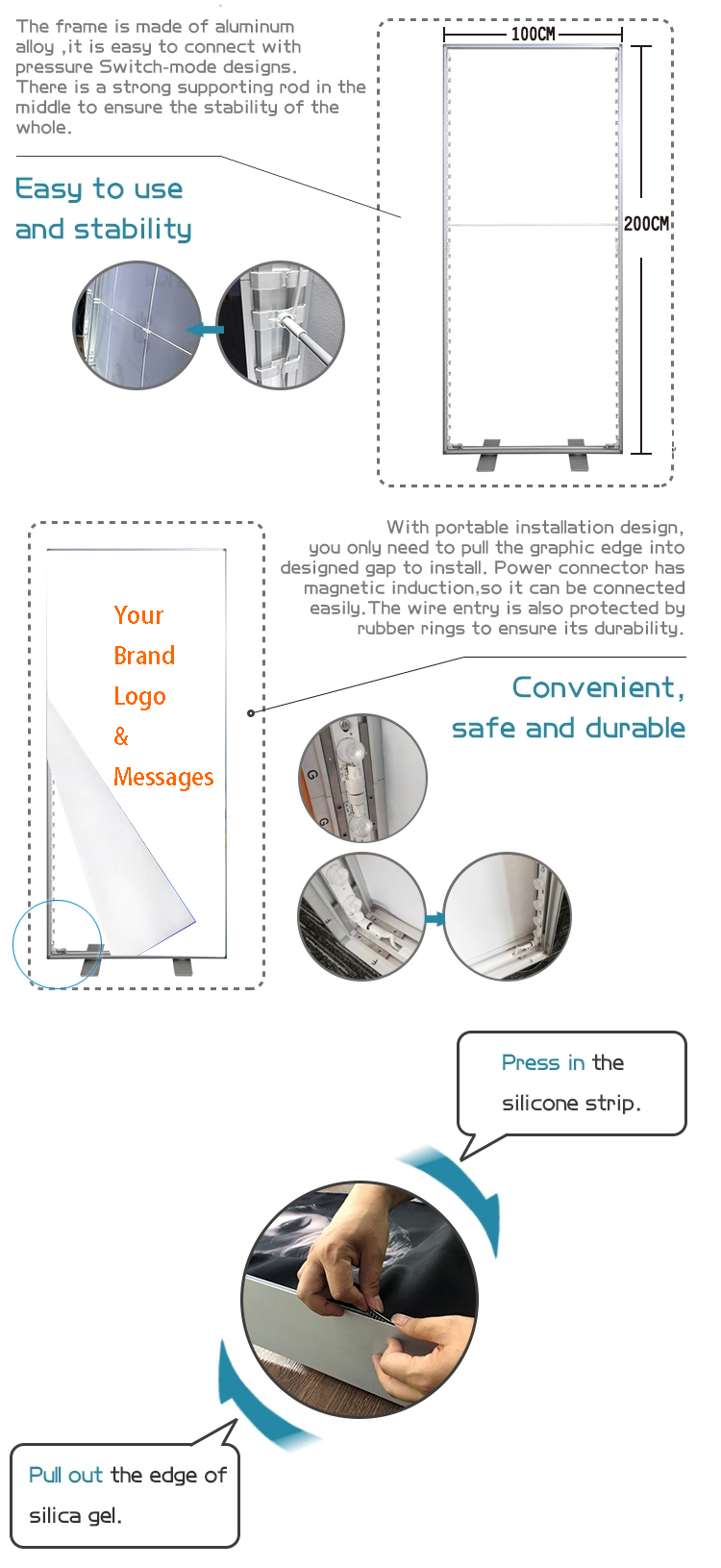
A SEG graphic is a printed fabric with a silicone strip welded around the edge. The strip presses into a groove machined into the aluminium profile. The printed area between the edges must be slightly smaller than the distance between the grooves, so the fabric sits under tension.
Tolerance is the agreed difference between those two numbers. If the graphic is cut exactly to the groove-to-groove size, the edge has nothing to push against and the face sags. If it is cut too small, the silicone will not reach the groove bottom and the graphic can pop out. Between those failures sits a workable band, and it is narrower than most buyers expect.
It is not the same as print bleed. Bleed protects the image area during trimming; tolerance controls the finished size of the whole graphic including the edge.
Tolerance failures show up at the worst moment: a store changeover with a graphic that will not seat, or a campaign wall that develops ripples two weeks after install. The costs are predictable.
Three numbers decide the fit: the frame’s groove-to-groove distance, the silicone edge diameter, and the finished graphic size. The printer sizes the fabric so that after the edge is welded on, the total assembly sits under even tension in the frame.
Fabric behaves like a material, not a sheet of paper. Dye-sublimation heating can shrink some textiles slightly. Humidity moves natural blends more than polyester. A graphic printed in a dry workshop and installed in a humid mall can change dimensions by a millimetre or two across a large face. That movement is why the workable band exists instead of a single exact size.
Large faces make it harder. A 300 mm wide graphic that drifts 0.5% loses 1.5 mm. The same drift on a 3 m wall loses 15 mm, which is a failed fit. Wide graphics therefore need proportionally tighter process control, not the same percentage rule.
| Situation | Tolerance pressure | What to confirm |
|---|---|---|
| Reorder for an existing frame | Highest — the frame is fixed and the old graphic is the only reference | Groove spec and the finished size of a known-good graphic |
| Large wall over 2 m | High — small percentage errors become large absolute errors | Measured size on site, not a drawing from memory |
| Humid climate or spa/pool area | High — fabric movement after install | Fabric choice and a slightly higher tension target |
| Multi-store rollout | Medium — consistency between sites matters more than one perfect fit | One template, one print batch per wave |
| Small poster frames | Lower — short edges forgive small errors | Standard sizes and a physical sample first |
| Finished size vs groove distance | What happens on site | Long-term behaviour |
|---|---|---|
| Exactly on-size (0 mm) | Edge seats with no tension; the face sags and ripples | Wrinkles appear within days as fabric relaxes |
| About 2 mm short (per metre) | Edge presses to the groove bottom; face reads flat | Holds tension through humidity swings |
| 5 mm or more short | Edge may not reach the groove; corners pucker or the graphic pops out | Failed fit; reprint required |
| Longer than the groove distance | Will not install without force and heat | Distorted print and stretched artwork; reprint required |
The practical rule many fabricators use is roughly 1–2 mm per metre of edge, capped so corners stay workable. Treat it as a question to ask, not a universal constant. Every frame system and fabric combination settles on its own band.
Buyers often describe both issues as “the graphic is wrinkled”, but the fixes differ.
| Tolerance problem | Tension problem | |
|---|---|---|
| Symptom | Edge will not seat, or seats with no resistance | Edge seats but the face ripples between bars |
| Cause | Finished size outside the workable band | Fabric weight, weave or print stretch mismatched to the depth |
| Fix | Resize and reprint with a confirmed template | Change fabric spec or light arrangement; rarely a reprint |
| Prevention | Measure a known-good graphic before reordering | Approve a sample with the graphic fitted |
| Worth it | Skip it |
|---|---|
| Reorders for frames already on the wall | First-time artwork where a sample will be made anyway |
| Large faces above 2 m wide | Small poster faces with short edges |
| Rollouts where every store must match | One-off event graphics with a short service life |
| Humid or temperature-swing locations | Dry, stable interior corridors |
It is the agreed difference between the finished graphic size and the frame’s groove-to-groove distance. The graphic must sit slightly under tension so the silicone edge presses into the groove and the face reads flat.
Many fabricators work with roughly 1–2 mm per metre of edge, but the right band depends on the profile, bead and fabric. Ask the frame maker for the target and confirm it with a sample before a batch.
Usually not cleanly. Stretching distorts the print and overloads the weld. A graphic outside the workable band should be reprinted from a corrected template.
Most often the finished size left too little tension, or the fabric moved after install in a humid space. Check the edge seating first, then the fabric spec against the original.
Yes. The bead diameter and the groove decide how much compression is available. A 10 mm bead in a 12 mm groove behaves differently from a matched pair, so the whole combination must be specified together.
Both own a part of it. The frame maker owns the groove and the target; the printer owns trimming, edging and the finished size. Put both numbers in one document so neither has to guess.
We will reply within 2 hours.
You can also use the contact page and attach a photo of the frame groove or the old graphic edge.