Address
Caochang Industrial Area, Liguang Rd, Lishui, Nanhai, Foshan, Guangdong, China
Phone:
0086-20-8938 9313
0086-757-8938 9313
Email:
Work Hours
Monday to Friday: 8AM - 10PM
24x7 online service

Address
Caochang Industrial Area, Liguang Rd, Lishui, Nanhai, Foshan, Guangdong, China
Phone:
0086-20-8938 9313
0086-757-8938 9313
Email:
Work Hours
Monday to Friday: 8AM - 10PM
24x7 online service
Custom LED Light Box & SEG Display Manufacturer
Make a light-box freight quotation traceable to the packages that will actually leave the warehouse. Confirm each handling unit’s finished external dimensions, gross weight and identification, then have the selected transport service explain its billing rules against that same list. Resolve differences between the measured packing, the quotation and the booking before collection.
This guide helps display importers, retail rollout coordinators and distributors who already have an offered display configuration. The useful output is a measured package register and a reconciled freight quotation. Keep the display’s purchase price, local installation budget and wider landed-cost comparison in their own project records.
Start with the accepted display and packing revisions. List whether the shipment will travel as individual cartons, cartons consolidated on a pallet, a crate or another agreed handling unit. A drawing of a shallow light box does not define the dimensions of its finished package. Separate sizes, constructions and packing arrangements when their measurements differ.
Connect each carton reference to its contents and quantity. If accessories or graphics travel in a shared carton, identify the displays or stores it serves. Reconcile the total display quantity against the contents list before requesting a rate. This prevents an apparently complete freight quote from omitting a loose-parts carton or a separate graphic package.
For palletized goods, ask the forwarder which level it will rate and book: the completed pallet, the cartons individually or another stated basis. Keep the carton-to-pallet map, but do not add carton volume to the same pallet’s external volume as if they were two separate shipments. State any plan to split the load later; a central-warehouse booking and separate store deliveries have different scopes.
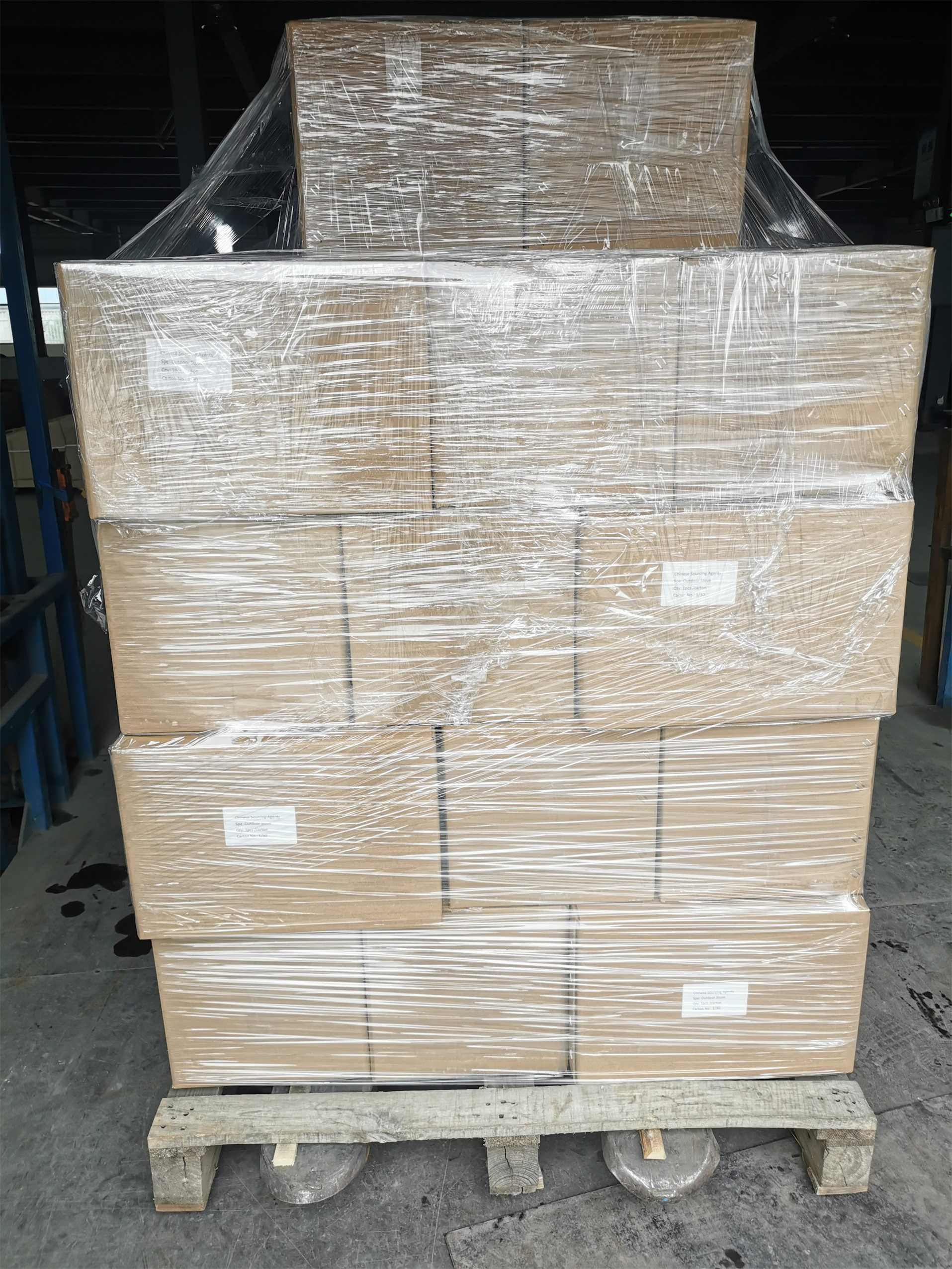
Request measurements after the proposed protection, closures, straps and outer packing are in place. Record the maximum external length, width and height under the selected service’s measurement method. For a pallet or crate, include the complete external handling unit, including its base and any projecting protective structure. Ask how irregular shapes and overhang are assessed instead of measuring only the neat rectangular part of the load.
Record gross weight with the packing included. Keep the measurement date, package reference, equipment used and the person supplying the figures with photographs that make the readings and package identity understandable. A carton supplier’s nominal box size and a calculated packing weight are useful planning inputs; label them as estimates until the finished package has been checked.
If several units share a packing design, identify which units were measured and why the figures are expected to apply to the remaining packages. Recheck exceptions rather than copying one value across a mixed shipment. Ask the packing team to work within its safe handling procedure; buyers should request records rather than moving or lifting a heavy load to obtain a photograph.
| Record line | What to identify | Measurement or decision evidence | Question to close before booking |
|---|---|---|---|
| Carton or handling-unit ID | Package reference, display/packing revision, contents and quantity | Final package list matched to the order and carton-to-pallet map | Does every shipped item have one traceable allocation? |
| External dimensions | Maximum finished length, width and height, with units | Measured record and identified views of the completed package | Are projections, protection and the pallet/crate base included where required? |
| Gross weight | Weight of the handling unit as offered for collection | Dated weighing record tied to that unit | Is the figure measured, estimated or awaiting confirmation? |
| Repeated package type | Count of packages to which one measurement applies | Common packing revision, sampled unit references and recorded exceptions | Do any sizes, contents or protection arrangements need separate lines? |
| Handling restrictions | Permitted orientation, stacking status and agreed handling method | Packing instructions reviewed with the warehouse and transport provider | Has the quoted service accepted these actual restrictions? |
| Receiving scope | Named delivery point and unloading/booking requirements | Receiving-team confirmation linked to the freight request | Can that site receive the offered handling units using the agreed arrangements? |
Ask for the applicable route, service, quotation date and validity, followed by the method used to determine the billed quantity. For a service using dimensional weight, obtain the dimensional factor, measurement units, rounding sequence and whether rating is performed per package or at another level. Compare dimensional and gross weight only under that service’s stated rules. Do not adopt a divisor from an unrelated calculator.
Keep the original measurements separate from any dimensions rounded for rating. Where a dimensional calculation is required, the length, width, height and factor must use compatible units. Retain the unrounded result and the service’s rounded billable result. A forwarder should be able to connect its quoted billable quantity to the identified package lines without relying on the visible depth of the display.
Geometric volume is a separate record: multiply external dimensions expressed in the same unit, then convert the result consistently. For example, cubic centimetres convert to cubic metres by dividing by 1,000,000. A calculated cubic volume is not itself a freight price, a chargeable weight or proof that a load can be stacked. Ask the provider to explain any minimum, space-based or other rating basis used for the actual service.
Check the treatment of separate packages before combining results. Per-package rounding or minimums can produce a different total from rounding an aggregate once. Record how the quoted service handles this, and retain a package-by-package calculation where applicable. If the quotation cannot be reproduced from the supplied records, keep the difference open and request the missing rule or corrected line.
Ask the packing and receiving teams to review the offered load’s footprint, overall height, gross weight, orientation and handling access. Record whether another load may be placed above it, under what approved conditions, and whether the selected route can honor the restriction. Wrapping cartons together or printing a handling symbol does not establish load capacity or acceptance by a transport network.
Have the provider identify any length, size, weight, non-stackable, special-handling or other charges that apply to this exact load. Request the applicable threshold and charge basis in the quotation instead of assuming every large package has the same surcharge. Keep charges that are included, separately quoted or pending confirmation distinguishable.
A smaller proposed package may change protection, assembly or receiving work. Review the revised packing with the product and logistics owners before comparing rates. The separate export packing guide for long profiles and fragile light boxes covers support and protection approval. A freight calculation does not demonstrate that a package protects its contents.
Issue the same controlled package list with each transport request. Record the named collection and delivery points, booked service, handling restrictions, included work and unresolved charges. Keep the display order quantity separate from the transport handling-unit count. Ask for a corrected quotation if the quoted load or service does not match the planned collection.
| Difference | Evidence to compare | Responsible review and next action | Closure record |
|---|---|---|---|
| Quotation uses product dimensions | Product drawing versus measured finished-package record | Packing owner supplies external dimensions; provider recalculates the affected lines. | Revised quotation and matching package-register revision. |
| Pallet dimensions omit its base or protection | Finished-load photographs, complete dimensions and booking entry | Warehouse confirms the offered unit; provider checks its measurement method and acceptance. | Correct handling-unit outline and any changed rating or handling decision. |
| Billable quantity does not reconcile | Gross weight, dimensional inputs, units, factor, rounding and minimums | Provider explains its actual service rule or corrects the calculation. | Traceable calculation linked to each affected package or rated unit. |
| Handling restriction is absent from the offer | Packing instruction, receiving constraint and service quotation | Transport and receiving owners confirm acceptance and applicable work/charges. | Written handling scope, revised service or another approved packing plan. |
| Measured load changes after quotation | Old/new packing revisions, dimensions, weight and package count | Buyer asks for re-rating and checks booking details before collection. | Accepted revised quote and booking using the actual final load. |
| Later carrier measurement differs | Package ID, original measurement evidence, carrier’s measurement and rating explanation | Responsible logistics contact reviews the difference through the agreed query process. | Documented explanation, corrected record or unresolved query; no assumed adjustment. |
Give each discrepancy an owner, affected unit references, the missing evidence and a required decision. For a simple planning example, a quotation may describe loose cartons while the collection request lists a wrapped pallet. The remedy is to reconcile the actual handling unit and rating basis; adding the pallet’s weight to the earlier total alone does not settle every changed assumption. This is an illustrative review, not a reported BrandMate shipment.
After dispatch, retain the collection record, final packing list, relevant photographs and provider documents. If a later measurement or charge differs, request the package identity, measured values and applicable rating explanation. Follow the agreed enquiry process and timing; this guide does not promise a refund, claim acceptance or a particular transport outcome.
Retain one issued set connecting display revision, packing design, package measurements, handling restrictions and accepted freight quotation. Update it when the size mix, contents, protective materials, pallet arrangement, destination or service changes. An earlier shipment’s figures are a starting reference; identify what has been checked for the next load.
For multiple stores, keep each destination allocation traceable without duplicating the same packages across the master list. Confirm where consolidation ends and separate delivery begins. Share the final package count and largest handling-unit outline with the receiving lead so unloading and site access can be planned before arrival.
For the wider equipment, transport and installation budget, use the separate LED light box landed-cost comparison guide. Keep this freight record focused on the measured load, transport quotation and collection booking.
Share the display format, finished size, quantity by size, destination and intended receiving arrangement. Include the available packing drawing, package register and any restrictions that the transport provider must review. Ask BrandMate which packing figures are measured, which are estimates and which depend on a final configuration. Request project-specific packing and documentation confirmation before treating them as booking data.
Start with the LED SEG light box range for a fabric-faced display. Discuss package records through Warehouse & Logistics and packing verification through Quality Control. Available configurations, transport arrangements and commercial terms require a reply for the actual project.
Use the completed package dimensions and gross weight. The cabinet drawing does not include every protection layer, accessory carton or pallet feature. Ask the selected provider to rate the actual offered handling units.
Obtain the factor and units for the selected service, route and current quotation, including its rounding and minimum rules. A calculation copied from another service is not a confirmed basis for this booking.
Compare the actual alternatives with the same protection and delivery requirements. A pallet changes the handling unit, dimensions, gross weight and possible restrictions. Have the provider quote those alternatives explicitly.
Compare the identified package, original measurement evidence, provider’s measured values and applicable rating method. Ask the responsible logistics contact to resolve the difference through the agreed process; retain the explanation and any corrected documents.
Discuss the package register on WhatsApp or email the proposed shipment to BrandMate.
Tell BrandMate about the display and where it will be used. Share drawings and detailed specifications during the project discussion.